ChipApex | Global Electronic Components Supplier

SEARCH
Search Product
Search Post
— IC芯片 | 连接器 | 传感器 | 被动器件 —
Search productSearch post
— IC芯片 | 连接器 | 传感器 | 被动器件 —
Consult the customer manager about the wholesale price.
consultation hotline:86-132-6715-2157
email:[email protected]
Contact the product manager for consultation. One-stop consultation is available.
Do you want a lower wholesale price? Please send us your inquiry and we will reply immediately.
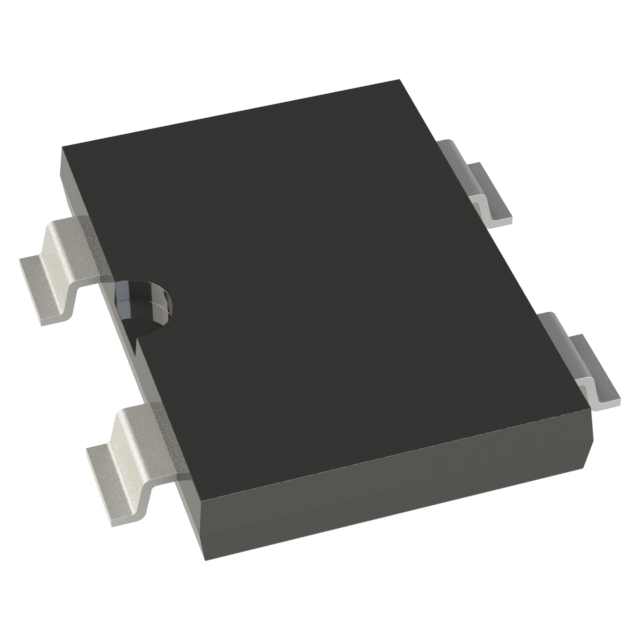
The HBS410-13 is a 4.0A surface mount glass passivated bridge rectifier manufactured by Diodes Incorporated. It features a peak repetitive reverse voltage of 1,000V and an average rectified output current of 4.0A at +25°C. The forward voltage drop reaches a maximum of 0.98V at 4A, with a leakage current of 5μA at full reverse voltage. The device operates within a temperature range of -55°C to +150°C and utilizes the HBS surface mount package.
Verify the specific ordering suffix '-13' corresponds to the commercial grade tape and reel packaging containing 2,500 units per reel. Confirm that the component meets RoHS directives and is halogen and antimony free as defined by the manufacturer's green product standards before finalizing procurement specifications.
Select this component when a 1,000V rating and 4.0A continuous current are required in a compact surface mount form factor. Ensure thermal management accounts for the junction-to-ambient resistance of 75°C/W. Verify that the application does not require automotive qualification, as standard versions lack AEC-Q100 certification.
This part belongs to Diodes Incorporated's HBS series of surface mount bridge rectifiers. The series offers various voltage ratings while maintaining a consistent 4.0A current capacity and standardized HBS package dimensions. This allows designers to maintain footprint compatibility across different voltage requirements in power supply designs.
Check datasheets for other HBS series variants such as HBS610 or HBS810 if lower voltage ratings are acceptable. Verify pinout compatibility and thermal characteristics against alternative manufacturers' 4-pin bridge rectifiers in similar packages before substitution.
The device supports a non-repetitive peak forward surge current of 120A for an 8.3ms single half sine-wave superimposed on rated load.
Standard parts are not automatically qualified for automotive use. For applications requiring AEC-Q100/101/200 qualification and IATF 16949 manufacturing, customers must contact Diodes Incorporated directly.
The typical thermal resistance from junction to ambient (RθJA) is 75°C/W per element, tested under specific mounting conditions on a fin heatsink.
 HBS410-13

The activity of extra discounts on wholesale prices is in full swing…
Please fill in your contact information and we will send you the latest wholesale price list.