ChipApex | Global Electronic Components Supplier
SEARCH
Search Product
Search Post
— IC芯片 | 连接器 | 传感器 | 被动器件 —
Search productSearch post
— IC芯片 | 连接器 | 传感器 | 被动器件 —
Consult the customer manager about the wholesale price.
consultation hotline:86-132-6715-2157
email:[email protected]
Contact the product manager for consultation. One-stop consultation is available.
Do you want a lower wholesale price? Please send us your inquiry and we will reply immediately.
The HCPL-4100 is a single-channel, 8-pin DIP optocoupler designed for isolated 20 mA current loop transmission. It features data input compatibility with LSTTL, TTL, and CMOS logic families. The device supports a maximum baud rate of 20 kbps and provides an isolation voltage of 3750 Vrms. Typical rise and fall times are 16 ns and 23 ns, respectively. It operates within a temperature range of -40°C to 85°C and includes an internal shield for high common-mode rejection.
Verify the specific suffix (e.g., -000E or -500E) against the required packaging configuration, such as tube or MouseReel, as these denote physical handling differences rather than functional changes. Confirm that the component meets CSA and UL 1577 certification requirements for your specific safety standards. Ensure the operating temperature range aligns with your environmental specifications before finalizing procurement.
Select this component when designing systems that require isolation for 20 mA current loop signals. It is suitable for applications needing compatibility with standard logic families like LSTTL and CMOS. Consider its 20 kBaud data rate limit and 3750 Vrms isolation rating when evaluating system performance requirements against other optocouplers in the HCPL series.
The HCPL-4100 belongs to Broadcom's HCPL series of optocouplers, which are widely used for signal isolation in industrial and commercial electronics. This specific model focuses on current loop transmission, distinguishing it from general-purpose logic output variants by its optimization for 20 mA loop parameters and associated interface characteristics.
HCPL-4200 is documented as a related device for complementary receiver applications in current loop systems. Direct substitution requires verification of pinout compatibility and electrical parameter alignment with the original design specifications.
The data input is compatible with LSTTL, TTL, and CMOS logic families.
Yes, the device incorporates an internal shield designed to provide high common-mode rejection.
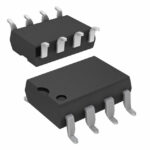 HCPL-4100#500
The activity of extra discounts on wholesale prices is in full swing…
Please fill in your contact information and we will send you the latest wholesale price list.