 ChipApex | Global Electronic Components Supplier

SEARCH
Search Product
Search Post
— IC芯片 | 连接器 | 传感器 | 被动器件 —
Search productSearch post
— IC芯片 | 连接器 | 传感器 | 被动器件 —
Consult the customer manager about the wholesale price.
consultation hotline:86-132-6715-2157
email:[email protected]
Contact the product manager for consultation. One-stop consultation is available.
Do you want a lower wholesale price? Please send us your inquiry and we will reply immediately.
The HEF40175BTT-Q100J is a quad D-type flip-flop manufactured by Nexperia, designed for automotive and industrial applications. It features four independent positive-edge-triggered D-type flip-flops within a single package. The device operates with a supply voltage range of 3.0 V to 15.0 V and complies with AEC-Q100 Grade 1 qualification standards. It is housed in a TSSOP-14 (SOT402) surface-mount package, ensuring reliable performance across specified temperature ranges while maintaining low power dissipation typical of CMOS logic families.
Verify the complete part number including the -Q100J suffix to ensure AEC-Q100 automotive qualification compliance. Confirm the TSSOP-14 package variant matches your PCB footprint requirements. Check RoHS status and chemical content declarations for regulatory adherence. Ensure supplier authorization through Nexperia or certified distributors to guarantee component authenticity and traceability.
Select this component when a quad D-type flip-flop is required for automotive-grade environments. Consider the 3.0 V to 15.0 V supply range compatibility with existing system rails. Evaluate the TSSOP-14 package dimensions against available board space. Compare propagation delay specifications against timing constraints if high-speed operation is necessary for the specific application design.
This component belongs to the HEF4000B series of CMOS logic devices, adapted for automotive use with Q100 qualification. It serves as a fundamental building block for sequential logic circuits. The device complements other Nexperia logic ICs like inverters and counters, providing standardized symmetrical output characteristics and high noise immunity suitable for demanding electronic environments.
Direct substitutes may include other AEC-Q100 qualified quad D-type flip-flops in TSSOP-14 packages from compatible manufacturers. Verify pinout compatibility and electrical parameter equivalence before substitution. Non-automotive grade equivalents lack the required qualification standards and should not be used in certified automotive applications without rigorous validation.
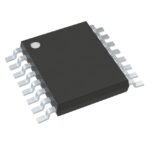 HEF40175BTT-Q100J

The activity of extra discounts on wholesale prices is in full swing…
Please fill in your contact information and we will send you the latest wholesale price list.






