 ChipApex | Global Electronic Components Supplier
SEARCH
Search Product
Search Post
— IC芯片 | 连接器 | 传感器 | 被动器件 —
Search productSearch post
— IC芯片 | 连接器 | 传感器 | 被动器件 —
Consult the customer manager about the wholesale price.
consultation hotline:86-132-6715-2157
email:[email protected]
Contact the product manager for consultation. One-stop consultation is available.
Do you want a lower wholesale price? Please send us your inquiry and we will reply immediately.
The HVMA03F40C-ST10S is an automotive grade board mount flyback transformer from Bourns, designed for high-voltage isolation applications. It features a compact ER9.5 core geometry with dimensions of 10.3 x 9.5 x 12.2 mm. The component supports an input voltage range of 6-27 VDC and provides a regulated output of 14 VDC at 0.2 A, delivering 3W of power. It operates within a switching frequency range of 12 kHz to 400 kHz and withstands a working voltage up to 900V across a 5000m clearance distance.
Verify the specific datasheet version and manufacturing date code upon order confirmation. Confirm that the package style and pinout match the target PCB footprint exactly. Ensure the supplier is an authorized distributor to guarantee component authenticity and traceability. Check for any recent design changes or obsolescence notices directly from Bourns before finalizing procurement plans.
Select this component when a 3W isolated DC-DC conversion is required in automotive platforms. The 14V output aligns with standard vehicle electrical architectures. The wide input range accommodates typical automotive battery fluctuations. Verify thermal management requirements as the transformer dissipates heat during operation. Ensure the switching controller supports the specified 12kHz to 400kHz frequency range for optimal efficiency.
This part belongs to Bourns' HVM series of high-voltage magnetics, specifically engineered for automotive compliance. The HVMA prefix indicates a flyback topology optimized for isolation barriers. The ST10S suffix denotes the specific winding configuration and terminal style. This series complements other automotive-grade components like the SM91803AL signal transformers for complete system integration.
No public confirmed substitute part numbers are available in the provided documentation. Consult Bourns engineering support for cross-reference recommendations if this specific model is unavailable. Ensure any alternative meets the same AEC-Q200 qualification and dimensional constraints.
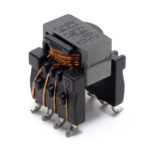 HVMA03F40C-ST10S
The activity of extra discounts on wholesale prices is in full swing…
Please fill in your contact information and we will send you the latest wholesale price list.





