ChipApex | Global Electronic Components Supplier

SEARCH
Search Product
Search Post
— IC芯片 | 连接器 | 传感器 | 被动器件 —
Search productSearch post
— IC芯片 | 连接器 | 传感器 | 被动器件 —
Consult the customer manager about the wholesale price.
consultation hotline:86-132-6715-2157
email:[email protected]
Contact the product manager for consultation. One-stop consultation is available.
Do you want a lower wholesale price? Please send us your inquiry and we will reply immediately.
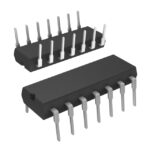
The ICL7650CPD is a chopper-stabilized operational amplifier in a 14-pin plastic DIP package, designed for low-level signal processing. It features a maximum input offset voltage of 10µV and an input bias current of 20pA over the commercial temperature range (0°C to +70°C). The device offers a unity-gain bandwidth of 2MHz, a slew rate of 2.5V/µs, and a minimum common-mode rejection ratio of 120dB. It includes an internal oscillator with a chopping frequency of 200Hz and an output clamp circuit to minimize overload recovery time.
Verify that the specific orderable part number matches the required package and temperature grade. Confirm that the component meets all electrical specifications for the intended operating environment. Ensure proper handling procedures are followed due to the sensitivity of CMOS inputs to electrostatic discharge.
Select this component when ultra-low DC offset and drift are critical requirements. The 14-pin package allows for optional external clocking or use of the internal oscillator. Consider the output clamp feature if fast recovery from saturation is necessary. Evaluate load driving capabilities as open-loop gain varies with load resistance.
This device belongs to the ICL7650 family of chopper-stabilized amplifiers manufactured by Maxim Integrated. It serves as an improved second source to Intersil's ICL7650B. The CPD suffix denotes the 14-pin Plastic DIP package with a commercial temperature range of 0°C to +70°C.
The ICL7653 is a compatible alternative within the same family that lacks the output clamp feature but offers slightly lower noise and improved AC common-mode rejection. Verify pin compatibility when replacing legacy devices like the LM741, noting that nulling capacitors connect to pins 1 and 8.
It uses a nulling scheme where a nulling amplifier alternately nulls itself and the main amplifier, providing continuous error correction to hold input offset voltage to a minimum.
The CLAMP pin connects to an output clamp circuit that reduces overload recovery time by preventing uncontrolled input differential and charge build-up on correction-storage capacitors during saturation.
 ICL7650CPD

The activity of extra discounts on wholesale prices is in full swing…
Please fill in your contact information and we will send you the latest wholesale price list.