 ChipApex | Global Electronic Components Supplier
SEARCH
Search Product
Search Post
— IC芯片 | 连接器 | 传感器 | 被动器件 —
Search productSearch post
— IC芯片 | 连接器 | 传感器 | 被动器件 —
Consult the customer manager about the wholesale price.
consultation hotline:86-132-6715-2157
email:[email protected]
Contact the product manager for consultation. One-stop consultation is available.
Do you want a lower wholesale price? Please send us your inquiry and we will reply immediately.
The ICS951412AGLF is a system clock synthesizer designed for ATI RS480-based platforms utilizing AMD K8 processors. It integrates a PLL to generate multiple clock signals from a single 14.318 MHz crystal input. The device provides outputs including three 14.318 MHz reference clocks, one 48 MHz USB clock, one HyperTransport seed, one PCI seed, two pairs of K8 CPU clocks, six pairs of SRC/PCI Express clocks, and two pairs of ATIG clocks. It operates on a 3.135 V to 3.465 V supply within a 56-TSSOP package.
Verify component authenticity through authorized distributors. Confirm RoHS compliance status as the part may be obsolete. Check for lead-free packaging specifications if required by assembly standards. Ensure the 56-TSSOP footprint matches the PCB design. Validate that the operating temperature range meets system requirements.
Select this component for legacy ATI RS480 architectures requiring precise AMD K8 clock ratios. Ensure the design supports the required 14.318 MHz external crystal. Verify that the 56-TSSOP package dimensions fit the available board space. Confirm that the SMBus interface is accessible for configuration during system initialization.
This component belongs to the ICS9514xx series of system clock chips. It is specifically tailored for desktop and workstation platforms based on the AMD K8 architecture. The device replaces discrete clock generators by integrating multiple PLLs and dividers into a single IC.
Publicly confirmed substitute part numbers are not available in the provided documentation. Due to the specialized nature of this chip for ATI RS480/K8 systems, direct pin-to-pin replacements may require schematic verification.
CPU frequency is selected using the FS0, FS1, and FS2 pins or via the SMBus interface. The specific frequency depends on the logic levels applied to these pins at power-up or written to the configuration register.
The IREF pin establishes the reference current for the differential current-mode output pairs (SRC clocks). It requires a fixed precision resistor tied to ground, typically 475 ohms, to set the appropriate output current.
Yes, the SRC outputs can be enabled or tri-stated using the CLKREQA# and CLKREQB# pins. These pins allow dynamic control over specific SRC clock pairs based on system requirements.
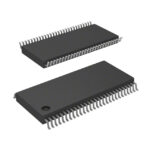 ICS951412AGLF
The activity of extra discounts on wholesale prices is in full swing…
Please fill in your contact information and we will send you the latest wholesale price list.






