 ChipApex | Global Electronic Components Supplier
SEARCH
Search Product
Search Post
— IC芯片 | 连接器 | 传感器 | 被动器件 —
Search productSearch post
— IC芯片 | 连接器 | 传感器 | 被动器件 —
Consult the customer manager about the wholesale price.
consultation hotline:86-132-6715-2157
email:[email protected]
Contact the product manager for consultation. One-stop consultation is available.
Do you want a lower wholesale price? Please send us your inquiry and we will reply immediately.
The ICS9FG104DFLFT is a frequency timing generator manufactured by Renesas Electronics Corporation, originally developed under the IDT brand. It provides four differential output pairs compliant with Intel CK410 specifications, supporting CPU, QPI, FBD, PCIe Gen 2, and SATA applications. The device synthesizes frequencies from 14.318 MHz or 25 MHz crystal inputs, delivering outputs with cycle-to-cycle jitter under 50 ps and output-to-output skew under 35 ps. It operates on a 3.135V to 3.465V supply within a 0°C to +70°C commercial temperature range, housed in a 28-pin SSOP package.
Verify the ordering suffix 'FLFT' corresponds to the Tape and Reel packaging variant of the 9FG104D series. Confirm the 'D' designation aligns with the commercial operating temperature range of 0°C to +70°C. Ensure compatibility with the 28-pin SSOP footprint during procurement planning.
Select this component when designing systems requiring compliance with Intel CK410 specifications for PCIe Gen 2 or SATA. Choose the 'DFLFT' variant over 'DFLF' if surface-mount reflow assembly via tape and reel is required. Verify that the input source matches the 14.318 MHz or 25 MHz crystal requirements supported by the SEL14M_25M# pin configuration.
This part belongs to the 9FG104 family of frequency generators. The 'D' suffix indicates the commercial temperature grade (0 to +70°C), while 'F' denotes lead-free/RoHS compliance. The 'LFT' suffix specifies the tape and reel shipping method. The device was originally an IDT product before integration into Renesas Electronics.
The 9FG104DFILFT serves as the industrial temperature grade replacement (-40 to +85°C). For TSSOP package variants, consider the 9FG104DGLFT series. Direct functional substitution requires verifying thermal operating ranges and package dimensions against the existing PCB layout.
The device supports two spread spectrum modes: 0 to -0.5% downspread and +/-0.25% centerspread.
Input frequency selection between 14.31818 MHz and 25 MHz is accomplished via the SEL14M_25M# pin or through SMBus software control.
The differential output pairs guarantee a cycle-to-cycle jitter of less than 50 ps.
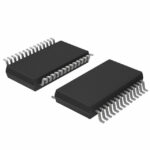 ICS9FG104DFLFT
The activity of extra discounts on wholesale prices is in full swing…
Please fill in your contact information and we will send you the latest wholesale price list.






