ChipApex | Global Electronic Components Supplier

SEARCH
Search Product
Search Post
— IC芯片 | 连接器 | 传感器 | 被动器件 —
Search productSearch post
— IC芯片 | 连接器 | 传感器 | 被动器件 —
Consult the customer manager about the wholesale price.
consultation hotline:86-132-6715-2157
email:[email protected]
Contact the product manager for consultation. One-stop consultation is available.
Do you want a lower wholesale price? Please send us your inquiry and we will reply immediately.
The INA186A2IYFDR is a bidirectional, low-power, zero-drift current-sense amplifier manufactured by Texas Instruments. It features a fixed gain of 50 V/V and operates with a supply voltage range of 1.7 V to 5.5 V. The device supports common-mode voltages from -0.2 V to +40 V independent of the supply. Key electrical specifications include a maximum offset voltage of ±50 µV, a minimum common-mode rejection ratio of 120 dB, and a typical quiescent current of 48 µA. It utilizes a DSBGA-6 package and functions within an operating temperature range of -40°C to +125°C.
Verify that the specific ordering suffix 'IYFDR' corresponds to the DSBGA-6 package variant when sourcing components. Confirm that the A2 designation matches the required 50 V/V gain for the target circuit design. Ensure compatibility with the YFD package type regarding thermal management and PCB layout requirements specified in the datasheet.
Select this component when bidirectional current monitoring is required alongside ultra-low power consumption. The 50 V/V gain option suits applications where moderate signal amplification is needed without excessive output saturation. Consider the DSBGA-6 package constraints if board space is limited, noting that this specific package variant does not support bidirectional sensing via an external REF pin.
This device belongs to the INA186 family of current-sense amplifiers designed for portable electronics and industrial systems. The family offers various gain options and packages, including SC70 and SOT-23-THIN. The INA186A2IYFDR specifically integrates the A2 gain setting into the compact DSBGA form factor, distinguishing it from larger package variants that may offer additional control pins like REF or ENABLE.
INA186A2IDCKR
No, the DSBGA (YFD) package used in the INA186A2IYFDR does not have an external REF pin. Consequently, it is configured for unidirectional current sensing only.
The ENABLE pin allows the user to turn off the device to reduce supply current to less than 0.1 µA. When disabled, the output enters a high-impedance state.
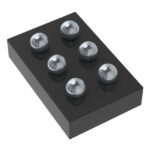 INA186A2IYFDR

The activity of extra discounts on wholesale prices is in full swing…
Please fill in your contact information and we will send you the latest wholesale price list.