ChipApex | Global Electronic Components Supplier

SEARCH
Search Product
Search Post
— IC芯片 | 连接器 | 传感器 | 被动器件 —
Search productSearch post
— IC芯片 | 连接器 | 传感器 | 被动器件 —
Consult the customer manager about the wholesale price.
consultation hotline:86-132-6715-2157
email:[email protected]
Contact the product manager for consultation. One-stop consultation is available.
Do you want a lower wholesale price? Please send us your inquiry and we will reply immediately.
The INA186A3IYFDR is a bidirectional, low-power, zero-drift current-sense amplifier manufactured by Texas Instruments. It features a fixed gain of 100 V/V and operates with a supply voltage range of 1.7 V to 5.5 V. The device supports common-mode voltages from -0.2 V to +40 V independent of the supply. Key electrical specifications include a maximum offset voltage of ±50 µV, a minimum common-mode rejection ratio of 120 dB, and a typical quiescent current of 48 µA. It is housed in a DSBGA-6 package.
Verify the specific suffix 'YFD' corresponds to the DSBGA-6 package configuration as documented in the datasheet. Confirm the 'A3' designation indicates the fixed 100 V/V gain option. Ensure the component meets RoHS compliance requirements if specified for your manufacturing process. Cross-reference the manufacturer part number with official Texas Instruments documentation to validate authenticity and revision status before procurement.
Select this component when bidirectional sensing is required within a 40-V common-mode range. The 100 V/V gain suits applications needing higher resolution for small shunt voltages. Consider the DSBGA-6 package for compact board space. Verify that the 35 kHz bandwidth meets system signal frequency requirements. Ensure the enable pin functionality aligns with power management strategies for low-quiescent-current operation.
This device belongs to the INA186 family of current-sense amplifiers designed for high-precision, low-power monitoring. The family offers various gain options and packages, including SC70 and SOT-23. The A3 variant specifically provides a 100 V/V gain. The YFD suffix denotes the DSBGA package type which includes an enable pin but lacks a dedicated reference pin, requiring internal grounding of the reference node.
INA186A3IDCKR
Yes, the device supports bidirectional current sensing. However, the YFD package does not have an external REF pin; the reference node is internally connected to ground, which typically configures it for unidirectional sensing unless modified by external circuitry or if the datasheet specifies internal biasing for bidirectional use in this specific package variant.
The ENABLE pin allows the user to turn the device off. When driven to GND, the supply current drops to less than 0.1 µA, and the output enters a high-impedance state. When driven to VS, the device operates normally.
The zero-drift architecture provides very low offset voltage and offset drift. This extends the dynamic range of the measurement, allowing for the use of smaller sense resistors with lower power loss while maintaining accuracy, particularly at light loads.
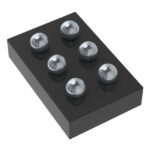 INA186A3IYFDR

The activity of extra discounts on wholesale prices is in full swing…
Please fill in your contact information and we will send you the latest wholesale price list.