 ChipApex | Global Electronic Components Supplier
SEARCH
Search Product
Search Post
— IC芯片 | 连接器 | 传感器 | 被动器件 —
Search productSearch post
— IC芯片 | 连接器 | 传感器 | 被动器件 —
Consult the customer manager about the wholesale price.
consultation hotline:86-132-6715-2157
email:[email protected]
Contact the product manager for consultation. One-stop consultation is available.
Do you want a lower wholesale price? Please send us your inquiry and we will reply immediately.
The INA2132UA/2K5 is a low-power, single-supply difference amplifier manufactured by Texas Instruments. It integrates a precision operational amplifier with a laser-trimmed resistor network to provide a fixed gain of 1 V/V. The device operates on a single supply voltage ranging from 2.7V to 36V or dual supplies from ±1.35V to ±18V. Key electrical parameters include a 300 kHz bandwidth, 70 dB common-mode rejection ratio (CMRR), and a maximum input offset voltage of 75 µV. It draws 160 µA of operating current and supports an output current of 12 mA per channel. The component functions within an extended industrial temperature range of -40°C to +85°C.
Verify the specific suffix '2K5' corresponds to the tape-and-reel packaging configuration when ordering. Confirm that the SOIC-8 package dimensions align with your PCB footprint requirements. Ensure the supply voltage remains within the specified 2.7V to 36V range to maintain performance specifications. Check for moisture sensitivity level compliance if the component has been exposed to ambient conditions prior to soldering.
Select this component when a fixed unity gain is required for differential signal conversion in low-power environments. It is suitable for replacing discrete resistor networks to save board space and improve matching accuracy. Consider the 300 kHz bandwidth limit for high-frequency applications. Evaluate the 70 dB CMRR against system noise requirements to ensure adequate signal integrity in noisy industrial settings.
This part belongs to the INA132 family of difference amplifiers from Texas Instruments. It is designed to simplify circuit design by integrating precision resistors internally. The UA/2K5 designation indicates the specific package type and reel quantity variant. It serves as a foundational building block for measurement circuits where common-mode voltages exceed the supply rails.
Direct pin-compatible alternatives may include other INA132 variants with different packaging options such as DIP or tube versions. Verify that substitute parts maintain the same 1 V/V gain and similar CMRR specifications to ensure circuit compatibility without redesign.
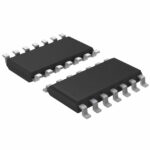 INA2132UA/2K5
The activity of extra discounts on wholesale prices is in full swing…
Please fill in your contact information and we will send you the latest wholesale price list.






