 ChipApex | Global Electronic Components Supplier
SEARCH
Search Product
Search Post
— IC芯片 | 连接器 | 传感器 | 被动器件 —
Search productSearch post
— IC芯片 | 连接器 | 传感器 | 被动器件 —
Consult the customer manager about the wholesale price.
consultation hotline:86-132-6715-2157
email:[email protected]
Contact the product manager for consultation. One-stop consultation is available.
Do you want a lower wholesale price? Please send us your inquiry and we will reply immediately.
The INA2332AIPWTG4 is a dual-channel instrumentation amplifier from Texas Instruments, housed in a TSSOP-14 package. It operates on a single supply voltage ranging from 2.5 V to 5.5 V with a typical quiescent current of 415 uA per channel. The device features a 2 MHz bandwidth and a slew rate of 5 V/us. Key electrical specifications include a common-mode rejection ratio (CMRR) of 60 dB, an input bias current of 10 pA, and an input offset voltage of 8 mV. The gain error is specified at 0.4%, while the power supply rejection ratio (PSRR) reaches 86.02 dB. It supports an operating temperature range from -55°C to +125°C.
Verify the specific suffix G4 indicates lead-free compliance and RoHS status according to the manufacturer's datasheet. Confirm the TSSOP-14 package dimensions and pinout match your PCB footprint requirements. Ensure the operating temperature range meets your environmental specifications. Cross-reference the exact part number with official Texas Instruments documentation to confirm availability and revision history before finalizing procurement.
Select this component when a dual-channel solution is required within a limited space constraint. Consider the 2 MHz bandwidth and 5 V/us slew rate for moderate-speed signal processing tasks. Evaluate the 60 dB CMRR against your noise environment requirements. Compare the 415 uA quiescent current against system power budgets. Verify that the 2.5 V to 5.5 V supply range aligns with your available power rails.
This part belongs to the INA2332 series of low-power, single-supply instrumentation amplifiers. It shares functional similarities with other devices in the family but differs in packaging and specific suffix designations. The TSSOP-14 package offers a surface-mount solution distinct from through-hole or smaller SOT options found in related product lines.
Check for direct substitutes like the INA2332AIPWR, noting differences in reel quantities. Verify compatibility with other INA2332 variants based on package type and suffix codes. Consult official substitution guides for pin-compatible alternatives if the exact part is unavailable.
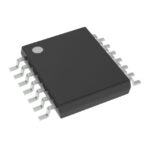 INA2332AIPWTG4
The activity of extra discounts on wholesale prices is in full swing…
Please fill in your contact information and we will send you the latest wholesale price list.






