ChipApex | Global Electronic Components Supplier
SEARCH
Search Product
Search Post
— IC芯片 | 连接器 | 传感器 | 被动器件 —
Search productSearch post
— IC芯片 | 连接器 | 传感器 | 被动器件 —
Consult the customer manager about the wholesale price.
consultation hotline:86-132-6715-2157
email:[email protected]
Contact the product manager for consultation. One-stop consultation is available.
Do you want a lower wholesale price? Please send us your inquiry and we will reply immediately.
The INA241A2QDRQ1 is an ultra-precise, bidirectional current sense amplifier from Texas Instruments. It features a fixed gain of 20V/V and operates with a supply voltage range of 2.7V to 20V. The device supports a wide common-mode input range from -5V to 110V, independent of the supply voltage. Key electrical specifications include a maximum offset voltage of ±3µV, a typical DC CMRR of 166dB, and a small-signal bandwidth of 1.1MHz at all gains. It is qualified under AEC-Q100 standards for Grade 1 automotive applications.
Verify the specific ordering suffix against the manufacturer's official documentation to confirm package type and temperature grade. Ensure the component meets the required AEC-Q100 Grade 1 specifications for your target application environment. Cross-reference the datasheet revision history to confirm compatibility with existing design parameters before finalizing procurement.
Select this component when high precision is required in high-side or low-side sensing applications involving significant common-mode voltage swings. The 20V/V gain option is suitable for optimizing full-scale output voltage relative to specific shunt resistor values. Consider the enhanced PWM rejection capabilities if the system experiences rapid common-mode transitions up to 125kHz.
This part belongs to the INA241x-Q1 family of ultra-precise current sense amplifiers designed for automotive environments. The 'A' designation indicates the highest precision tier within the series, characterized by superior offset voltage and gain error performance compared to other variants. The 'Q1' suffix confirms its qualification for automotive use according to AEC-Q100 standards.
Direct replacements within the same family include INA241A1QDRQ1 (10V/V gain) and INA241A3QDRQ1 (50V/V gain). Verify that the alternative gain setting aligns with the system's dynamic range requirements and that the package footprint remains compatible with the PCB layout.
The device supports an operational common-mode voltage range from -5V to 110V, which is independent of the power supply voltage.
It utilizes enhanced PWM rejection circuitry that holds the output for 1µs during large common-mode transients, preventing disturbances from propagating to the output signal.
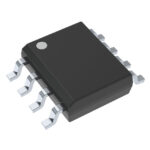 INA241A2QDRQ1
The activity of extra discounts on wholesale prices is in full swing…
Please fill in your contact information and we will send you the latest wholesale price list.