ChipApex | Global Electronic Components Supplier
SEARCH
Search Product
Search Post
— IC芯片 | 连接器 | 传感器 | 被动器件 —
Search productSearch post
— IC芯片 | 连接器 | 传感器 | 被动器件 —
Consult the customer manager about the wholesale price.
consultation hotline:86-132-6715-2157
email:[email protected]
Contact the product manager for consultation. One-stop consultation is available.
Do you want a lower wholesale price? Please send us your inquiry and we will reply immediately.
The INA241A5QDGSRQ1 is a bidirectional current sense amplifier from Texas Instruments, designed for automotive applications with AEC-Q100 qualification. It features a gain of 200 V/V and operates within a common-mode voltage range of -5 V to 100 V. The device supports a supply voltage between 2.7 V and 20 V, drawing 3.2 mA of operating current. Key electrical specifications include a maximum input offset voltage of 8 uV, an input bias current of 35 uA, and a CMRR of 150 dB. It offers a 3dB bandwidth of 1100 kHz and a gain error of 0.01%. The component is housed in a VSSOP-10 package and functions over a temperature range of -40°C to +125°C.
Verify the specific suffix 'Q1' confirms AEC-Q100 automotive grade compliance. Ensure the 'DGSR' package code matches the required VSSOP-10 form factor. Confirm the 'A5' gain setting corresponds to the 200 V/V requirement for your circuit design. Check the datasheet for moisture sensitivity levels and reflow soldering profiles suitable for your manufacturing process.
Select this part when bidirectional current monitoring is required in high common-mode voltage environments up to 100 V. The 200 V/V gain is suitable for detecting small voltage drops across low-value shunts. Consider the VSSOP-10 package for space-constrained PCB layouts. Verify that the 1100 kHz bandwidth meets the dynamic response needs of your application.
This component belongs to the INA241A family of current sense amplifiers. The 'Q1' designation indicates automotive qualification, while 'A5' specifies the fixed gain of 200 V/V. The 'DGSR' suffix denotes the VSSOP-10 package with tape-and-reel packaging. This series is engineered for robust performance in demanding automotive power electronics.
Yes, it can be used for low-side sensing, but its high common-mode voltage range makes it particularly advantageous for high-side applications where ground reference shifts occur.
The output is analog, providing a voltage signal proportional to the sensed current and the fixed 200 V/V gain.
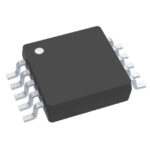 INA241A5QDGSRQ1
The activity of extra discounts on wholesale prices is in full swing…
Please fill in your contact information and we will send you the latest wholesale price list.