 ChipApex | Global Electronic Components Supplier
SEARCH
Search Product
Search Post
— IC芯片 | 连接器 | 传感器 | 被动器件 —
Search productSearch post
— IC芯片 | 连接器 | 传感器 | 被动器件 —
Consult the customer manager about the wholesale price.
consultation hotline:86-132-6715-2157
email:[email protected]
Contact the product manager for consultation. One-stop consultation is available.
Do you want a lower wholesale price? Please send us your inquiry and we will reply immediately.
The INA254A1IPWAR is a voltage-output current sense amplifier featuring an integrated 400-µΩ precision shunt resistor. It supports bidirectional current monitoring over a wide common-mode range of –4 V to +80 V, independent of the supply voltage. The device operates from a single 2.7-V to 5.5-V power supply with a maximum quiescent current of 2.4 mA. It utilizes a zero-drift chopped amplifier topology to provide calibration-equivalent measurement accuracy and ultra-low temperature drift performance. The specific A1 variant offers a fixed gain of 20 mV/A. It is housed in a 24-pin HTSSOP package.
Verify the specific ordering suffix IPWAR corresponds to the 24-pin HTSSOP package configuration. Confirm that the A1 designation matches the required 20 mV/A gain setting for your system design. Ensure compatibility with the specified 2.7-V to 5.5-V supply voltage range and check thermal derating requirements if operating near the upper ambient temperature limits.
Select this component when high-side or low-side bidirectional current sensing is required up to 80 V common-mode voltage. The integrated shunt eliminates external resistor tolerance errors and simplifies PCB layout. Choose the A1 gain version (20 mV/A) if the target full-scale output voltage requires lower amplification compared to the 40 mV/A or 75 mV/A variants available in the series.
This device belongs to the INA254 family of high-voltage, integrated precision shunt monitors. Unlike standard current sense amplifiers that require external shunts, the INA254 integrates the sensing element directly with the amplifier. This integration ensures matched thermal tracking between the resistor and the amplifier, significantly improving system-level accuracy and reducing temperature-induced measurement errors.
INA254A2IPWAR
The device features enhanced PWM rejection circuitry designed to attenuate large dv/dt common-mode transients associated with PWM signals, minimizing output disturbances without requiring excessive signal bandwidth.
These pins provide access to the positive and negative sense connections of the internal 400-µΩ shunt resistor. They can be connected to IN+ and IN– or an external filter network to optimize measurement accuracy.
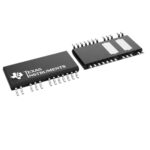 INA254A1IPWAR
The activity of extra discounts on wholesale prices is in full swing…
Please fill in your contact information and we will send you the latest wholesale price list.






