ChipApex | Global Electronic Components Supplier
SEARCH
Search Product
Search Post
— IC芯片 | 连接器 | 传感器 | 被动器件 —
Search productSearch post
— IC芯片 | 连接器 | 传感器 | 被动器件 —
Consult the customer manager about the wholesale price.
consultation hotline:86-132-6715-2157
email:[email protected]
Contact the product manager for consultation. One-stop consultation is available.
Do you want a lower wholesale price? Please send us your inquiry and we will reply immediately.
The INA310B4QDGKRQ1 is an AEC-Q100 qualified, ultra-precise current sense amplifier featuring a fixed gain of 200 V/V. It operates with a common-mode voltage range from –4 V to +110 V and supports supply voltages between 2.7 V and 20 V. Key electrical characteristics include a maximum offset voltage of ±200 µV, a typical CMRR of 140 dB, and a quiescent current of 1.6 mA. The device integrates an open-drain comparator with a 0.6 V internal reference and latching capability, housed in an 8-pin VSSOP package.
Verify the specific B-grade accuracy class and 200 V/V gain configuration against design requirements. Confirm automotive qualification status and functional safety documentation availability for integration into safety-critical systems. Ensure thermal management aligns with the specified junction-to-ambient resistance values for the VSSOP-8 package.
Select this variant when a fixed 200 V/V gain is required for high-resolution sensing of small differential voltages. The B-grade version offers higher offset voltage limits compared to the A-grade but maintains robust CMRR. Consider the integrated comparator for simplified overcurrent detection without external components. Evaluate the 1.6 mA quiescent current against system power budgets.
This component belongs to the INA310x-Q1 family of ultra-precise current sense amplifiers designed for automotive environments. The family provides multiple gain options ranging from 20 V/V to 500 V/V. The 'B' suffix denotes the B-grade accuracy tier, while 'Q1' indicates AEC-Q100 automotive qualification. The 'DGKR' suffix specifies the VSSOP-8 tape and reel packaging format.
INA310A4QDGKRQ1
Grounding or leaving the RESET pin open enables transparent mode where the output responds normally. Connecting it to the supply voltage activates latching mode, holding the output high after a trip event until the pin is reset.
While the operational range is up to 110 V, the device can survive transient voltages up to +120 V and down to -20 V on the analog inputs relative to ground.
No, the closed-loop gain is set by an internal precision resistor network. Adding external resistance is not recommended due to potential variations in absolute resistor values affecting accuracy.
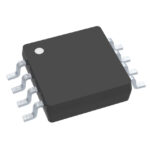 INA310B4QDGKRQ1
The activity of extra discounts on wholesale prices is in full swing…
Please fill in your contact information and we will send you the latest wholesale price list.