 ChipApex | Global Electronic Components Supplier
SEARCH
Search Product
Search Post
— IC芯片 | 连接器 | 传感器 | 被动器件 —
Search productSearch post
— IC芯片 | 连接器 | 传感器 | 被动器件 —
Consult the customer manager about the wholesale price.
consultation hotline:86-132-6715-2157
email:[email protected]
Contact the product manager for consultation. One-stop consultation is available.
Do you want a lower wholesale price? Please send us your inquiry and we will reply immediately.
The IQS7225A101QFR is a sensor fusion IC from the ProxFusion series, designed for inductive sensing applications requiring relative encoder functionality and multiple buttons. It supports self-capacitance, mutual-capacitance, and inductive modes via six configurable channels across nine external sensor pad connections. The device features an I2C interface with IRQ/RDY support up to 1 MHz, selectable addresses via GPIO, and Gray-coded relative encoder processing. Operating voltages range from 1.8 V to 3.5 V at 14 MHz or 2.2 V to 3.5 V at 18 MHz. It includes automatic tuning, noise filtering, and multi-level triggers within a QFN20 package.
Verify the specific ordering suffix '101' against official documentation to confirm clock frequency settings and power consumption characteristics. Ensure compatibility with the required I2C address configuration via the ADDR pin. Confirm that the QFN20 package footprint matches the recommended PCB layout guidelines provided in the datasheet.
Select this model when inductive sensing with relative encoder capabilities is required alongside capacitive button inputs. Consider the operating voltage range and oscillator frequency requirements based on system power constraints. Evaluate the need for specific low-power modes such as Ultra-Low Power or Halt mode depending on battery life expectations.
This component belongs to the Azoteq IQS7225A family within the IQ Switch ProxFusion series. It shares core sensing engine architecture with other variants in the series but differs in ordering suffixes which dictate factory-programmed settings and operational parameters.
Direct replacements must maintain the QFN20 package and I2C interface. Verify functional equivalence regarding inductive encoder resolution and channel count. Cross-reference ordering suffixes to ensure identical power mode behaviors and default register configurations.
The I2C address is selected using the ADDR pin. Pulling the pin high sets the address to 0x44, while pulling it low sets it to 0x45.
Automatic Tuning Implementation (ATI) optimizes device performance for varying sensor electrode capacitances and inductances without requiring external component modifications.
Yes, the IQS7225A offers four power modes: Normal, Low-Power, Ultra-Low Power, and Halt, allowing optimization of response time versus power consumption.
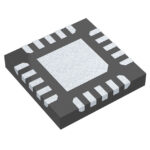 IQS7225A101QFR
The activity of extra discounts on wholesale prices is in full swing…
Please fill in your contact information and we will send you the latest wholesale price list.





