ChipApex | Global Electronic Components Supplier
SEARCH
Search Product
Search Post
— IC芯片 | 连接器 | 传感器 | 被动器件 —
Search productSearch post
— IC芯片 | 连接器 | 传感器 | 被动器件 —
Consult the customer manager about the wholesale price.
consultation hotline:86-132-6715-2157
email:[email protected]
Contact the product manager for consultation. One-stop consultation is available.
Do you want a lower wholesale price? Please send us your inquiry and we will reply immediately.
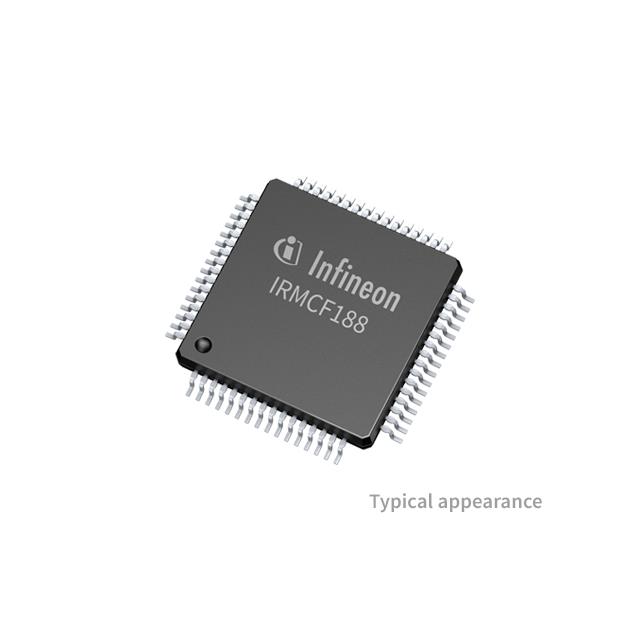
The IRMCF188TY is a discontinued IGBT-based motor driver IC from Infineon Technologies, part of the iMOTION and MCE series. It operates on a 3V to 3.6V supply voltage and features a 64-LQFP (12x12) surface-mount package. The device supports AC, DC, induction, and synchronous motors with integrated pre-drivers for three half-bridges. Key interfaces include I2C, RS-232, and SPI. It functions as a controller for commutation and direction management within an operating temperature range of -40°C to 85°C.
This component has been officially declared End-of-Life (EOL) by Infineon Technologies, with the discontinuation effective November 16, 2022. Procurement is restricted to existing stock or secondary market channels only. Verify RoHS3 compliance and湿气敏感性等级 (MSL) 3 status before integration. Due to the obsolete status, long-term supply availability cannot be guaranteed, and alternative sourcing strategies should be evaluated immediately.
Select this component only for legacy system maintenance or specific replacement scenarios where the iMOTION/MCE architecture is required. The 3V-3.6V supply constraint limits compatibility with higher voltage logic levels without additional level shifting. Consider the 64-LQFP footprint for PCB layout constraints. Evaluate thermal performance within the -40°C to 85°C ambient range to ensure reliable operation in the target environment.
The IRMCF188TY belongs to Infineon's iMOTION and MCE product families, designed for integrated motor control solutions. It combines power stage drivers with digital control capabilities on a single chip. As an IGBT-based solution, it targets medium-power applications requiring efficient switching. The device integrates essential peripherals for industrial and consumer motor drives, simplifying design complexity compared to discrete implementations.
No public confirmed substitute part numbers are available for this discontinued component. Engineers must evaluate newer generations within the iMOTION family or external gate driver combinations. Cross-reference pinouts and interface protocols carefully when selecting alternatives to ensure mechanical and electrical compatibility.
 IRMCF188TY
The activity of extra discounts on wholesale prices is in full swing…
Please fill in your contact information and we will send you the latest wholesale price list.