 ChipApex | Global Electronic Components Supplier
SEARCH
Search Product
Search Post
— IC芯片 | 连接器 | 传感器 | 被动器件 —
Search productSearch post
— IC芯片 | 连接器 | 传感器 | 被动器件 —
Consult the customer manager about the wholesale price.
consultation hotline:86-132-6715-2157
email:[email protected]
Contact the product manager for consultation. One-stop consultation is available.
Do you want a lower wholesale price? Please send us your inquiry and we will reply immediately.
The ISD1416P is a single-chip voice record/playback device from the ISD1400 series, manufactured by Winbond. It provides a 16-second recording duration with an 8.0 kHz sampling frequency and a 3.3 kHz filter passband. The device operates on a single +5V supply within commercial (0°C to 70°C) or industrial (-40°C to 85°C) temperature ranges. Key electrical parameters include a typical standby current of 1 µA, operating current of 30 mA, and speaker output power of 12.2 mW into a 16 Ω load. It features non-volatile Multi-Level Storage (MLS) for zero-power message retention.
Verify the package type matches the required form factor, as the ISD1416P is available in PDIP and SOIC configurations. Confirm the temperature grade corresponds to the application environment, distinguishing between commercial and industrial ratings. Ensure the specific ordering suffix aligns with lead-free requirements if mandated by the target assembly process.
Select the ISD1416P when a fixed 16-second duration at 8.0 kHz sampling rate is sufficient for the application. Consider the ISD1420 variant if a longer 20-second duration at 6.4 kHz is preferred. Evaluate the need for external clock precision via the XCLK pin if oscillator stability exceeds the internal tolerance limits over the operating voltage and temperature range.
The ISD1416P belongs to the ISD1400 ChipCorder series, which offers high-quality, single-chip solutions for short-duration messaging. This series leverages CMOS technology to integrate all necessary analog and digital functions onto one die, simplifying system design by eliminating the need for separate microcontrollers or memory chips for basic voice recording tasks.
The ISD1410 is a documented derivative within the same family offering similar functionality. For applications requiring extended durations, the ISD1420 provides a 20-second alternative. Verify pin compatibility and operational mode logic when substituting, as address pin interpretations may vary based on specific hardware configurations.
The device supports 160 distinct addressable segments. Address inputs A0-A7 function as start addresses unless both MSBs (A6 and A7) are HIGH, which activates special operational modes such as cueing, looping, or consecutive addressing.
The device automatically enters a low-power standby mode after completing a record or playback cycle. Standby current is typically 0.5 µA to 1 µA, eliminating the need for battery backup circuits due to zero-power message storage.
Yes, the device is compatible with microcontrollers. It can be controlled via the REC, PLAYE, and PLAYL pins, and operational modes can be hardwired or managed digitally to facilitate complex messaging sequences.
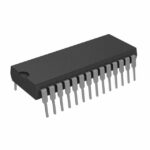 ISD1416P
The activity of extra discounts on wholesale prices is in full swing…
Please fill in your contact information and we will send you the latest wholesale price list.





