 ChipApex | Global Electronic Components Supplier
SEARCH
Search Product
Search Post
— IC芯片 | 连接器 | 传感器 | 被动器件 —
Search productSearch post
— IC芯片 | 连接器 | 传感器 | 被动器件 —
Consult the customer manager about the wholesale price.
consultation hotline:86-132-6715-2157
email:[email protected]
Contact the product manager for consultation. One-stop consultation is available.
Do you want a lower wholesale price? Please send us your inquiry and we will reply immediately.
The ISD1932SYI is a single-chip multiple-message record/playback device from the ISD1900 ChipCorder series by Nuvoton Technology Corporation. It supports dual operating modes: Address Mode and Direct Mode, allowing flexible message configuration via hardware pins or fixed configurations. The device operates on a supply voltage ranging from 2.4V to 5.5V. Sampling frequency selection is achieved through an external resistor (Rosc) connected to the Rosc pin, with options spanning 4 kHz to 12 kHz. At 8 kHz sampling frequency, the maximum recording duration is 32 seconds. The unit features differential microphone inputs with automatic gain control (AGC), a Class-D PWM speaker driver for direct drive, and feed-through capabilities.
Verify the specific suffix 'SYI' against the manufacturer's official ordering information to confirm package type and temperature grade. Ensure the selected derivative matches the required audio output configuration, as SP+ pin functions vary between differential speaker output and single-ended voltage output depending on the specific part number variant within the series.
Select the appropriate sampling frequency based on the desired balance between audio quality and memory duration using the external Rosc resistor. In Address Mode, configure start and end address pins to define specific message slots. For Direct Mode, utilize FMC pins to set the number of fixed messages. Ensure the power supply remains stable during operations to prevent data corruption.
The ISD1932SYI belongs to the ISD1900 ChipCorder series, which provides single-chip solutions for multiple-message recording and playback. This series is designed for standalone applications but can also be controlled by microcontrollers. The ISD1932 variant offers a middle-tier memory capacity compared to the ISD1916 and ISD1964 models in the same family.
ISD1932SOI
The sampling frequency is selected by connecting an external resistor (Rosc) between the Rosc pin and ground. Values range from 53.3 kΩ for 12 kHz to 160 kΩ for 4 kHz.
Address Mode allows variable message durations defined by start and end address pins. Direct Mode divides memory into up to eight equal-duration messages accessed via specific message control pins.
No, the device performs one operation at a time. However, in Feed-Through mode, analog input can be passed to speakers while recording, effectively allowing simultaneous monitoring and recording.
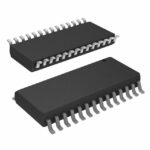 ISD1932SYI
The activity of extra discounts on wholesale prices is in full swing…
Please fill in your contact information and we will send you the latest wholesale price list.






