 ChipApex | Global Electronic Components Supplier
SEARCH
Search Product
Search Post
— IC芯片 | 连接器 | 传感器 | 被动器件 —
Search productSearch post
— IC芯片 | 连接器 | 传感器 | 被动器件 —
Consult the customer manager about the wholesale price.
consultation hotline:86-132-6715-2157
email:[email protected]
Contact the product manager for consultation. One-stop consultation is available.
Do you want a lower wholesale price? Please send us your inquiry and we will reply immediately.
The ISD4004-16MSI is a single-chip voice record/playback device from Nuvoton's ISD4004 series, designed for portable applications. It utilizes direct analog storage technology to store audio signals in on-chip Flash memory without A/D conversion. The component supports an 8-minute recording duration at an 8.0 kHz sampling frequency with a typical filter passband of 3.4 kHz. It operates on a single 3V supply, drawing 25 mA during recording and 15 mA during playback, with a standby current of 1 µA. The device features a 28-pin SOIC package and includes an SPI interface for microcontroller control.
Verify the specific suffix MSI confirms the 28-lead SOIC package type when sourcing components. Ensure the operating environment falls within the commercial temperature range of 0°C to +70°C for this packaged variant. Confirm that the application design accommodates separate analog and digital ground connections to minimize noise interference as specified in the datasheet.
Select the ISD4004-16MSI when a maximum 8-minute recording duration at high fidelity (8.0 kHz) is required. This model is suitable for designs needing low power consumption with a 1 µA standby current. Consider the industrial grade variants if operation below 0°C is necessary, as the MSI suffix denotes the commercial temperature range packaged unit.
The ISD4004 series represents Nuvoton's ChipCorder technology, replacing older magnetic media solutions. The -16 designation indicates the longest duration option within the base series, though the 8kHz sampling rate limits it to 8 minutes. The MSI suffix identifies the specific plastic small outline IC packaging configuration available for surface mount assembly.
WT2003HP8-32N is a documented alternative for ISD4004 voice record/playback applications.
The ANA IN+ pin has an input resistance of approximately 3 kΩ, while the ANA IN- pin has an input resistance of approximately 56 kΩ in differential mode.
The Row Address Clock (RAC) pin outputs a signal indicating the end of a memory row, which assists in managing multiple messages and preventing address repetition during consecutive operations.
No, all operations including recording and playback must be controlled by a master microcontroller via the SPI or Microwire serial interface; the chip cannot function autonomously.
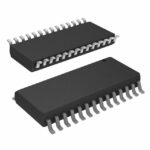 ISD4004-16MSI
The activity of extra discounts on wholesale prices is in full swing…
Please fill in your contact information and we will send you the latest wholesale price list.






