ChipApex | Global Electronic Components Supplier

SEARCH
Search Product
Search Post
— IC芯片 | 连接器 | 传感器 | 被动器件 —
Search productSearch post
— IC芯片 | 连接器 | 传感器 | 被动器件 —
Consult the customer manager about the wholesale price.
consultation hotline:86-132-6715-2157
email:[email protected]
Contact the product manager for consultation. One-stop consultation is available.
Do you want a lower wholesale price? Please send us your inquiry and we will reply immediately.
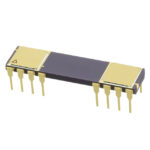
The ISO103 is a low-cost, internally powered isolation amplifier featuring a double-wide side-brazed ceramic package. It provides signal and power across an isolation barrier with a 1500Vrms continuous AC rating and 5600Vpk test voltage. The device supports a wide input signal range of ±10V to ±15V and offers a 20kHz bandwidth for both small-signal and full-power operation. Built-in isolated power supplies ±50mA from ±10V to ±18V inputs. Key electrical parameters include a nominal gain of 1 V/V, initial error of ±0.12% (ISO103) or ±0.08% (ISO103B), and a small-signal bandwidth of 20kHz.
Verify the specific suffix code on the component marking to confirm the exact grade variant, as performance tolerances differ between standard and precision versions. Confirm that the package type matches the required board layout dimensions, specifically the double-wide DIP footprint. Ensure the design accounts for the separate rectifier output pins if additional ripple filtering is necessary for the application's noise requirements.
Select this component when a compact solution is required to transmit analog signals while simultaneously powering external input conditioning circuitry on the isolated side. Consider the device for applications requiring high common-mode rejection and minimal barrier capacitance to reduce AC leakage currents. Evaluate the need for external synchronization logic if multiple units are used in close proximity to prevent carrier frequency beating.
The ISO103 belongs to the Burr-Brown isolation amplifier family, now managed by Texas Instruments. It utilizes a proprietary 800kHz oscillator and square core wirebonded transformer technology. The device is designed for high-reliability environments, undergoing 100% barrier breakdown testing conforming to UL1244 standards. It serves as a cost-effective alternative to optically coupled linear isolation amplifiers.
The ISO103B is available as a higher-precision variant within the same package and pinout configuration. Designers should verify if the tighter gain accuracy and lower offset voltage of the ISO103B are required for the specific application tolerance levels.
 ISO103

The activity of extra discounts on wholesale prices is in full swing…
Please fill in your contact information and we will send you the latest wholesale price list.