 ChipApex | Global Electronic Components Supplier

SEARCH
Search Product
Search Post
— IC芯片 | 连接器 | 传感器 | 被动器件 —
Search productSearch post
— IC芯片 | 连接器 | 传感器 | 被动器件 —
Consult the customer manager about the wholesale price.
consultation hotline:86-132-6715-2157
email:[email protected]
Contact the product manager for consultation. One-stop consultation is available.
Do you want a lower wholesale price? Please send us your inquiry and we will reply immediately.
The KBP005G is a single-phase standard recovery bridge rectifier manufactured by Diodes Incorporated. It features an average rectified output current of 1.5 A at a case temperature of +105°C and a maximum repetitive peak reverse voltage of 50 V. The forward voltage drop is limited to 1.1 V at the rated current, with a maximum leakage current of 5 µA at +25°C. The device supports a non-repetitive peak forward surge current of 40 A and operates within a junction temperature range of -55°C to +150°C. It utilizes a KBP through-hole package with matte tin terminals.
Verify the specific ordering suffix 'G' corresponds to lead-free and RoHS compliance as defined in the manufacturer's documentation. Confirm that the tube packaging quantity matches the required production volume. Ensure the component meets all applicable environmental directives before finalizing procurement specifications.
Select this component when a 50 V blocking voltage and 1.5 A continuous current are required in a KBP package. Consider the thermal resistance of 18 °C/W per element when designing heatsinking solutions. Verify that the operating frequency aligns with standard recovery diode capabilities rather than ultra-fast switching requirements.
This part belongs to the KBP005G–KBP10G series of 1.5 A bridge rectifiers from Diodes Incorporated. The series offers various voltage ratings ranging from 50 V to 1000 V while maintaining consistent current and package specifications. It serves as a standardized solution for low-power rectification tasks across multiple industrial and consumer electronics segments.
Direct substitutes include other 1.5 A, 50 V bridge rectifiers in the KBP package such as the KBP005 from different manufacturers. Ensure equivalent forward voltage, leakage current, and thermal performance characteristics are matched during replacement evaluation.
The maximum repetitive peak reverse voltage (VRRM) for the KBP005G is 50 V.
No, the KBP005G is a standard recovery bridge rectifier designed for general-purpose applications, not high-frequency switching.
The typical thermal resistance from junction to case (RθJC) is 18 °C/W per element.
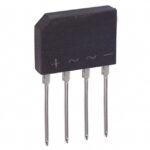 KBP005G

The activity of extra discounts on wholesale prices is in full swing…
Please fill in your contact information and we will send you the latest wholesale price list.





