 ChipApex | Global Electronic Components Supplier

SEARCH
Search Product
Search Post
— IC芯片 | 连接器 | 传感器 | 被动器件 —
Search productSearch post
— IC芯片 | 连接器 | 传感器 | 被动器件 —
Consult the customer manager about the wholesale price.
consultation hotline:86-132-6715-2157
email:[email protected]
Contact the product manager for consultation. One-stop consultation is available.
Do you want a lower wholesale price? Please send us your inquiry and we will reply immediately.
The KBP10M-E4/51 is a single-phase bridge rectifier manufactured by Vishay General Semiconductor - Diodes Division. It features a peak repetitive reverse voltage of 1 kV and an average forward rectified current of 1.5 A. The device exhibits a maximum forward voltage drop of 1.1 V at 3.14 A and a leakage current of 5 µA at 1000 V. Designed for through-hole mounting in the 4-SIP, KBPM package, it operates within a junction temperature range of -55°C to 150°C. This component complies with RoHS 2002/95/EC standards.
This specific part number is officially discontinued and no longer manufactured. Verification of availability requires checking authorized distributors for remaining stock or identifying equivalent active components from the same manufacturer family. Ensure any substitute maintains identical electrical ratings and physical footprint compatibility for existing PCB layouts.
Select this component only if legacy design compatibility is required. For new designs, consider active alternatives within the KBP series that offer updated manufacturing support. Verify that the 1.5 A current rating and 1 kV voltage withstand capability align with the specific circuit requirements before integration.
The KBP10M-E4/51 belongs to the KBP series of glass passivated single-phase bridge rectifiers. This series is characterized by its compact SIP package and robust construction suitable for general-purpose rectification tasks. The 'E4' suffix indicates lead (Pb)-free compliance, while '/51' denotes the standard packaging configuration.
KBP10G and KBP210G are listed as similar replacement options by Diodes Incorporated. These parts share comparable electrical characteristics but may differ in minor physical dimensions or thermal properties. Validate pinout compatibility and thermal management requirements when substituting these active components.
The maximum non-repetitive peak forward current is 50 A.
Yes, the component is solder dip compatible at 260 °C for 40 seconds and conforms to RoHS 2002/95/EC and WEEE 2002/96/EC directives.
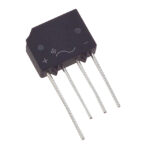 KBP10M-E4/51

The activity of extra discounts on wholesale prices is in full swing…
Please fill in your contact information and we will send you the latest wholesale price list.





