ChipApex | Global Electronic Components Supplier

SEARCH
Search Product
Search Post
— IC芯片 | 连接器 | 传感器 | 被动器件 —
Search productSearch post
— IC芯片 | 连接器 | 传感器 | 被动器件 —
Consult the customer manager about the wholesale price.
consultation hotline:86-132-6715-2157
email:[email protected]
Contact the product manager for consultation. One-stop consultation is available.
Do you want a lower wholesale price? Please send us your inquiry and we will reply immediately.
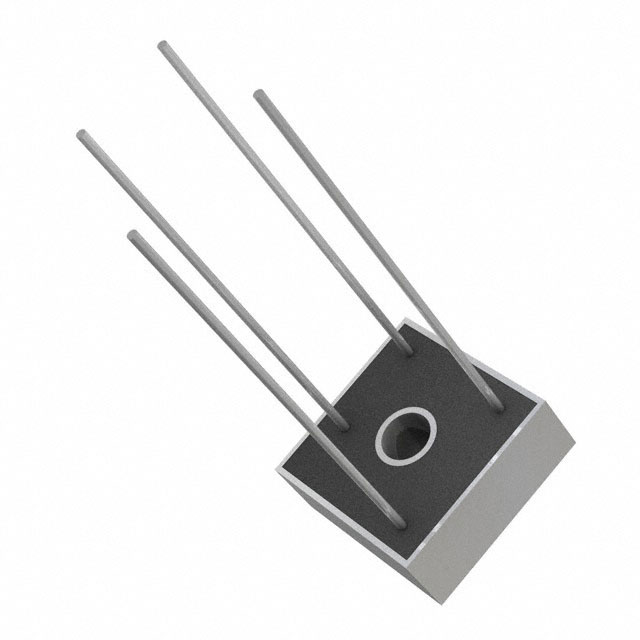
The KBPC25005W-G is a single-phase bridge rectifier manufactured by Comchip Technology, designed for high-current applications. It features an average forward current rating of 25 A and a repetitive peak reverse voltage of 50 V. The device exhibits a maximum forward voltage drop of 1.1 V and supports a non-repetitive peak forward surge current of 400 A. It operates within a temperature range from -55 °C to +150 °C junction temperature. The component utilizes a screw mount installation style with through-hole termination in the KBPC-W-4 package. Physical dimensions are 28.8 mm in length and width, with a height of 11.23 mm.
Verify compliance with RoHS directives before integration. Confirm that the screw mount configuration matches the mechanical assembly requirements. Ensure the PCB or chassis layout accommodates the specific KBPC-W-4 footprint dimensions. Validate thermal management strategies to maintain junction temperatures within the specified operational limits during continuous load conditions.
Select this component when a 25 A current capacity and 50 V blocking voltage are required in a screw-mountable package. Compare against the KBPC50005W-G if higher current ratings are needed. Consider the GBU25005-G for through-hole solder pin applications instead of screw mounting. Verify that the 1.1 V forward voltage drop aligns with system efficiency targets.
This part belongs to the KBPC25005 series of single-phase silicon bridge rectifiers. It shares the KBPC-W-4 package form factor with other variants in the family but differs in electrical ratings based on the suffix codes. The manufacturer specifies distinct performance characteristics for each model within this series to address varying voltage and current demands.
Cross-reference with KBPC25005 from other manufacturers such as Liteon or Diodes Incorporated for equivalent electrical specifications. Verify package compatibility and terminal configurations before substitution. Ensure that alternative sources meet the same thermal and surge current requirements.
 KBPC25005W-G

The activity of extra discounts on wholesale prices is in full swing…
Please fill in your contact information and we will send you the latest wholesale price list.