ChipApex | Global Electronic Components Supplier
SEARCH
Search Product
Search Post
— IC芯片 | 连接器 | 传感器 | 被动器件 —
Search productSearch post
— IC芯片 | 连接器 | 传感器 | 被动器件 —
Consult the customer manager about the wholesale price.
consultation hotline:86-132-6715-2157
email:[email protected]
Contact the product manager for consultation. One-stop consultation is available.
Do you want a lower wholesale price? Please send us your inquiry and we will reply immediately.
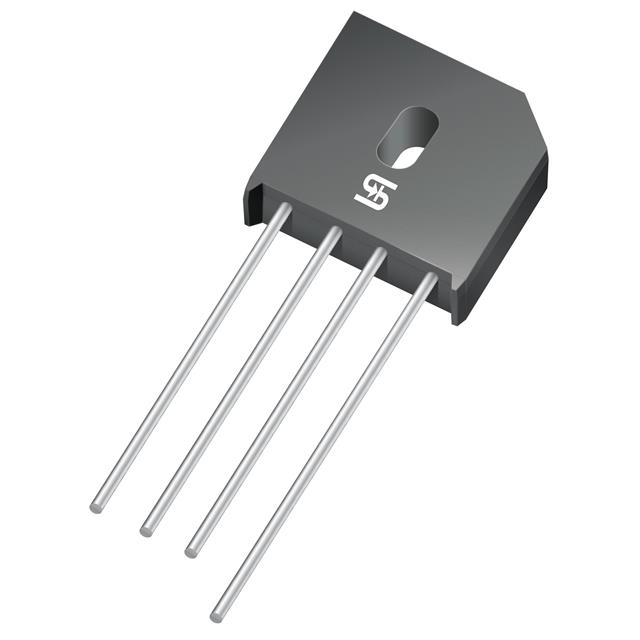
The KBU804G T0G is a glass passivated bridge rectifier from the KBU series manufactured by Taiwan Semiconductor Corporation. It provides a maximum repetitive peak reverse voltage of 400V, a maximum RMS voltage of 280V, and a maximum DC blocking voltage of 400V. The device supports a maximum average forward rectified current of 8A and a peak forward surge current of 200A for an 8.3ms single half-sine wave. Typical instantaneous forward voltage is 1.0V at 4A and 1.1V at 8A. Maximum DC reverse current is 5μA at 25°C and 500μA at 125°C. Operating junction and storage temperature ranges are -55°C to +150°C.
Verify the specific ordering suffix 'T0G' corresponds to the green compound packing code as documented. Confirm compliance requirements such as UL recognition file E-326243 and JESD 201 class 1A whisker test status match project specifications. Ensure mechanical mounting torque does not exceed 0.56 Nm during installation to prevent damage to the component.
Select this component when a 400V reverse voltage rating and 8A continuous current capacity are required. Consider the KBU package form factor for printed circuit board mounting applications. Evaluate thermal resistance values if heatsinking or derating curves are necessary for high ambient temperature operations.
This part belongs to the KBU801G through KBU807G family of glass passivated bridge rectifiers. The series offers varying voltage ratings from 50V to 1000V while maintaining a consistent 8A current capability. The KBU804G specifically addresses the 400V requirement within this standardized product line.
Direct substitutes include other KBU804 variants from different manufacturers offering identical 400V/8A specifications. Verify pinout compatibility and physical dimensions before substitution to ensure proper fit on existing PCB layouts.
The typical junction capacitance per leg is 400pF, measured at 1MHz with an applied reverse voltage of 4.0V DC.
No, the 'G' suffix indicates the use of a green halogen-free molding compound according to IEC 61249-2-21 definitions, without altering electrical functionality.
The maximum mounting torque is 0.56 Nm to prevent mechanical damage to the bridge rectifier case.
 KBU804G T0G
The activity of extra discounts on wholesale prices is in full swing…
Please fill in your contact information and we will send you the latest wholesale price list.