ChipApex | Global Electronic Components Supplier

SEARCH
Search Product
Search Post
— IC芯片 | 连接器 | 传感器 | 被动器件 —
Search productSearch post
— IC芯片 | 连接器 | 传感器 | 被动器件 —
Consult the customer manager about the wholesale price.
consultation hotline:86-132-6715-2157
email:[email protected]
Contact the product manager for consultation. One-stop consultation is available.
Do you want a lower wholesale price? Please send us your inquiry and we will reply immediately.
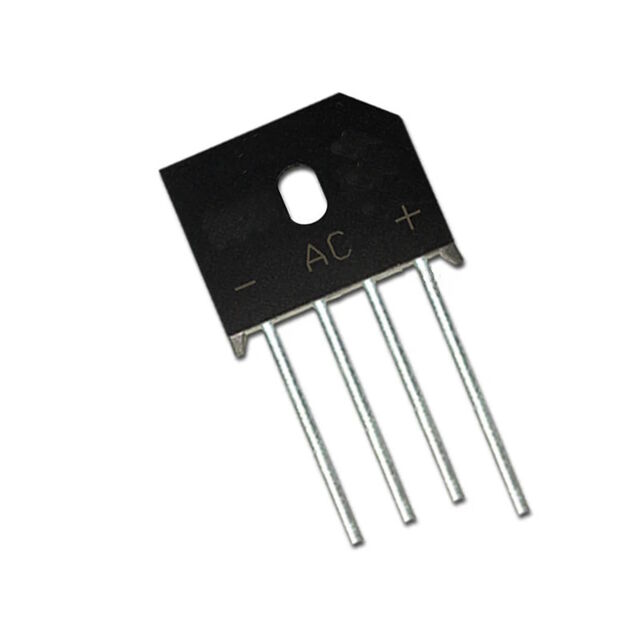
The Lumimax Optoelectronic Technology KBU810G is a single-phase glass passivated bridge rectifier designed for printed circuit board mounting. It features a molded plastic KBU case with UL 94V-0 flame retardant epoxy and solderable terminals compliant with MIL-STD-202, method 208. The device supports a maximum repetitive peak reverse voltage of 1000 V and a maximum average forward rectified current of 8.0 A at 100°C case temperature. It withstands a peak forward surge current of 300 A under an 8.3 ms half-sine-wave condition. The component operates within a junction and storage temperature range of -50 to +150°C, with a typical junction capacitance of 250 pF per diode measured at 1.0 MHz.
Verify the manufacturer part number against official Lumimax documentation to ensure authenticity. Confirm that the ordering suffix matches the required voltage rating, as the KBU8 series spans multiple voltage options. Check for updated revision numbers, as specifications are subject to change without notice. Ensure compatibility with standard KBU footprint requirements during procurement planning.
Select the KBU810G when a 1000 V reverse voltage rating is required alongside an 8 A continuous current capacity. Consider the KBU package dimensions for PCB layout constraints. Derate the forward current by 20% if the application involves capacitive loads. Verify thermal management capabilities to maintain the case temperature within the specified 100°C limit for full current rating.
The KBU810G belongs to the KBU8 series of glass passivated bridge rectifiers from Lumimax Optoelectronic Technology. This series covers a voltage range from 50 V to 1000 V, sharing common mechanical and electrical characteristics such as the KBU package and 8.0 A current rating. The '10' suffix indicates the specific 1000 V variant within this standardized product line.
Cross-reference with other manufacturers offering KBU-style bridge rectifiers rated for 1000 V and 8 A. Verify pinout polarity markings and physical dimensions match the existing PCB design. Ensure equivalent surge current ratings and thermal characteristics are met before substitution.
 KBU810G

The activity of extra discounts on wholesale prices is in full swing…
Please fill in your contact information and we will send you the latest wholesale price list.