 ChipApex | Global Electronic Components Supplier

SEARCH
Search Product
Search Post
— IC芯片 | 连接器 | 传感器 | 被动器件 —
Search productSearch post
— IC芯片 | 连接器 | 传感器 | 被动器件 —
Consult the customer manager about the wholesale price.
consultation hotline:86-132-6715-2157
email:[email protected]
Contact the product manager for consultation. One-stop consultation is available.
Do you want a lower wholesale price? Please send us your inquiry and we will reply immediately.
The L6470PDTR is a fully integrated microstepping motor driver with a digital motion engine and SPI interface, designed for two-phase bipolar stepper motors. It operates within an 8V to 45V supply range and delivers up to 3A RMS phase current with a 7.0A peak capability. The device features a dual low RDS(on) DMOS full bridge with accurate on-chip current sensing for non-dissipative control. It supports resolutions from 1 to 1/128 steps and includes programmable acceleration, deceleration, speed, and positioning profiles via SPI registers.
Verify the specific suffix PDTR corresponds to the PowerSO-36 Slug Up package and tape-and-reel packaging format. Confirm that the component meets RoHS3 compliance standards as indicated by manufacturer documentation. Ensure compatibility with the required SPI communication protocol and voltage levels before integration into the final design.
Select this component when a fully integrated solution combining power stage and motion control logic is required. It is suitable for designs needing high-resolution microstepping and advanced protection features without complex external circuitry. Consider the PowerSO-36 package for thermal performance in space-constrained applications requiring up to 3A RMS current handling.
This part belongs to the STSPIN L64 series of motor drivers. It is distinct from variants like the L6470H which may differ in package or pinout. The L6470 family is characterized by its dSPIN technology, enabling simplified system architecture by integrating the motion controller directly with the power driver stage.
Direct substitutes include other L6470 variants such as L6470H, provided the package and pinout compatibility are verified. Cross-model selection should account for differences in thermal characteristics and physical footprint between PowerSO-36 and other available packages within the same product line.
Yes, the device supports a daisy-chain SPI configuration, allowing multiple units to be controlled sequentially using a single SPI master interface.
The device includes programmable non-dissipative overcurrent protection on both high-side and low-side switches, along with two-level overtemperature protection.
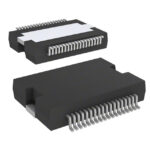 L6470PDTR

The activity of extra discounts on wholesale prices is in full swing…
Please fill in your contact information and we will send you the latest wholesale price list.





