 ChipApex | Global Electronic Components Supplier
SEARCH
Search Product
Search Post
— IC芯片 | 连接器 | 传感器 | 被动器件 —
Search productSearch post
— IC芯片 | 连接器 | 传感器 | 被动器件 —
Consult the customer manager about the wholesale price.
consultation hotline:86-132-6715-2157
email:[email protected]
Contact the product manager for consultation. One-stop consultation is available.
Do you want a lower wholesale price? Please send us your inquiry and we will reply immediately.
The L6563S is a current-mode Power Factor Correction (PFC) controller operating in Transition Mode (TM). It features a highly linear multiplier and a special correction circuit to reduce mains current crossover distortion, enabling wide-range operation with extremely low Total Harmonic Distortion (THD). The device includes an accurate internal voltage reference with 1% tolerance at 25 °C. Voltage feedforward function optimizes loop stability and improves line transient response during mains drops or surges. It supports tracking boost operation where output voltage tracks mains voltage.
Verify the specific suffix of the part number to confirm package type and reel specifications. Confirm that the selected variant matches the required operating temperature range and pin configuration for the target design. Ensure compatibility with the intended PWM controller interface if used in a cascaded system.
Select this component for designs requiring low THD across a wide load range without complex control architectures. It is suitable for applications needing bidirectional line transient response and remote ON/OFF control capabilities. Consider its interface with downstream DC-DC converters for light-load energy saving compliance.
The L6563S is an enhanced version of the L6563, maintaining the same pin-out while offering improved performance and additional functions. It belongs to the L6563S/L6563H/L6564D family of PFC controllers from STMicroelectronics. It is designed to replace older models in existing designs while providing better efficiency and harmonic reduction.
The L6563 serves as the direct predecessor with identical pin-out. Verify functional equivalence regarding the enhanced features such as the specific THD correction circuit and voltage feedforward techniques before substitution.
It utilizes a voltage feedforward function (1/V2 correction) that significantly improves line transient response during both mains drops and surges.
The IC provides overvoltage protection, protection against feedback loop failures, brownout handling, and detection of boost inductor saturation.
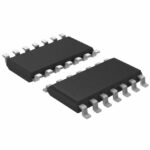 L6563S
The activity of extra discounts on wholesale prices is in full swing…
Please fill in your contact information and we will send you the latest wholesale price list.







