 ChipApex | Global Electronic Components Supplier

SEARCH
Search Product
Search Post
— IC芯片 | 连接器 | 传感器 | 被动器件 —
Search productSearch post
— IC芯片 | 连接器 | 传感器 | 被动器件 —
Consult the customer manager about the wholesale price.
consultation hotline:86-132-6715-2157
email:[email protected]
Contact the product manager for consultation. One-stop consultation is available.
Do you want a lower wholesale price? Please send us your inquiry and we will reply immediately.
The L9958 is a fully integrated bipolar motor driver manufactured by STMicroelectronics, designed for controlling brushed DC and stepper motors. It features two half-bridge outputs capable of delivering up to 8.6A output current with a supply voltage range of 4.5V to 5.5V and load voltages from 4V to 28V. The device utilizes a CMOS technology and communicates via an SPI interface for digital control. Packaged in a 16-PowerBSOP (PowerSO-16) surface-mount enclosure, it operates within a junction temperature range of -40°C to 150°C.
Verify the specific suffix of the part number, as variants such as L9958SBTR and L9958XPTR may differ in qualification standards like AEC-Q100. Confirm availability status, noting that some versions are marked as Not Recommended for New Designs. Ensure compatibility with required packaging formats and check for any recent production change notices affecting assembly or materials.
Select this component when a single-chip solution for bipolar motor control is required. It is suitable for applications needing integrated protection against faults like short circuits and thermal runaway. Consider the PowerSO-16 package constraints and ensure adequate thermal management for continuous operation. Verify that the system voltage requirements align with the specified input ranges before finalizing the design.
The L9958 belongs to a family of motor drivers from STMicroelectronics, often paired with microcontrollers like STM32 for complete motion control solutions. It serves as a dedicated power stage for managing motor loads while handling communication through serial interfaces. This IC is positioned for applications demanding robust performance in compact form factors, bridging the gap between simple discrete drivers and complex multi-phase controllers.
Check datasheets for alternative ST models or competitors offering similar half-bridge configurations. Verify pinout compatibility and electrical parameter overlaps if substituting directly. Note that some related products may be designated as obsolete or not recommended for new designs.
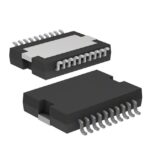 L9958

The activity of extra discounts on wholesale prices is in full swing…
Please fill in your contact information and we will send you the latest wholesale price list.





