ChipApex | Global Electronic Components Supplier

SEARCH
Search Product
Search Post
— IC芯片 | 连接器 | 传感器 | 被动器件 —
Search productSearch post
— IC芯片 | 连接器 | 传感器 | 被动器件 —
Consult the customer manager about the wholesale price.
consultation hotline:86-132-6715-2157
email:[email protected]
Contact the product manager for consultation. One-stop consultation is available.
Do you want a lower wholesale price? Please send us your inquiry and we will reply immediately.
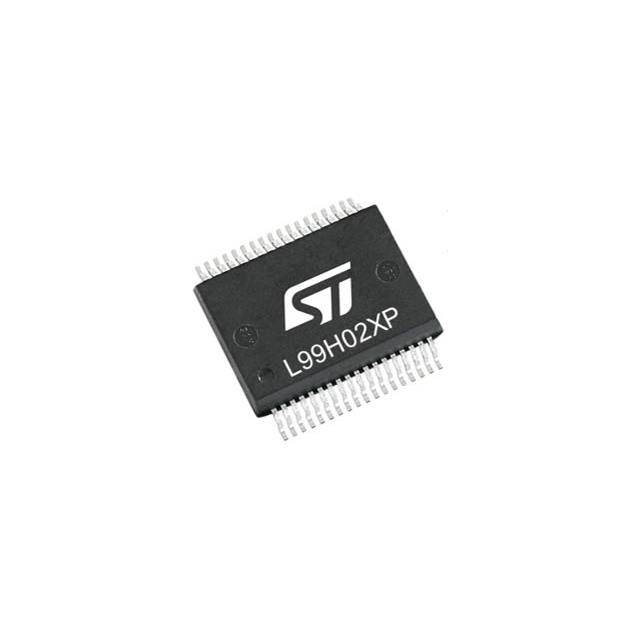
The L99H02XPTR is a motor bridge driver designed for automotive applications, specifically intended to drive four external N-channel MOS transistors configured in an H-bridge topology. It integrates a freely configurable current detection amplifier and features a standard Serial Peripheral Interface (SPI) for device control and diagnostic information retrieval. The component includes an interface pin for external MOSFET thermal sensors and supports PWM operation with frequencies up to 30 kHz. It operates within a supply voltage range of 6 V to 28 V and is qualified under the AEC-Q100 standard.
Verify that the specific suffix 'PTR' corresponds to the required tape-and-reel packaging format as defined by STMicroelectronics. Confirm that the component meets the AEC-Q100 qualification requirements necessary for your specific automotive application environment. Ensure that the SPI interface compatibility aligns with your system's microcontroller or controller architecture before finalizing procurement.
Select this component when designing automotive motor control systems requiring an integrated bridge driver solution. It is suitable for applications needing precise current monitoring via the internal amplifier and robust diagnostic capabilities through the SPI interface. Consider the 6 V to 28 V operating range and the integration of thermal sensor interfaces when evaluating system-level power and safety requirements.
The L99H02XPTR belongs to the L99H02 family of motor bridge drivers manufactured by STMicroelectronics. This series is engineered for automotive environments, providing a complete solution for controlling external power stages. The part number indicates the specific package and reel configuration variant within the broader product line designed for high-reliability vehicle electronics.
The L99H02QFTR is a publicly confirmed substitute part number within the same family, offering similar functional capabilities but potentially differing in package type or reel specifications. Verify pinout and electrical parameter compatibility before substitution.
 L99H02XPTR

The activity of extra discounts on wholesale prices is in full swing…
Please fill in your contact information and we will send you the latest wholesale price list.