 ChipApex | Global Electronic Components Supplier
SEARCH
Search Product
Search Post
— IC芯片 | 连接器 | 传感器 | 被动器件 —
Search productSearch post
— IC芯片 | 连接器 | 传感器 | 被动器件 —
Consult the customer manager about the wholesale price.
consultation hotline:86-132-6715-2157
email:[email protected]
Contact the product manager for consultation. One-stop consultation is available.
Do you want a lower wholesale price? Please send us your inquiry and we will reply immediately.
The LD6815TD/29P,125 is a low dropout regulator (LDO) from the NXP LD6815 series. It provides a fixed nominal output voltage of 2.9 V with a maximum output current of 150 mA. The device operates within an input voltage range of 2.3 V to 5.5 V and features a typical dropout voltage of 250 mV at full load. It offers high power supply rejection ratio (PSRR) of 75 dB at 1 kHz and low RMS output noise of 40 µV in the 10 Hz to 100 kHz bandwidth. The component includes overcurrent protection and utilizes an SOT753 (TSOP5) plastic surface-mounted package.
Verify the specific suffix 'P' confirms the inclusion of the pull-down auto-discharge feature rather than the high-ohmic variant. Confirm the '125' suffix aligns with the required packing quantity or orientation specifications for the SOT753 package. Ensure the operating temperature range meets the application requirements of -40 °C to +85 °C ambient temperature.
Select this component when a stable 2.9 V rail is required with minimal voltage drop under heavy loads up to 150 mA. The pull-down output characteristic makes it suitable for systems requiring rapid discharge of output capacitance upon shutdown. Consider the small SOT753 footprint for space-constrained designs while ensuring adequate thermal management on the PCB.
This part belongs to the LD6815 series of low dropout regulators designed for portable electronics. The series shares common characteristics such as high PSRR and low noise but varies by output voltage and output stage behavior. The 'TD' indicates the TSOP5 package type, while the '/29' specifies the 2.9 V nominal output voltage setting.
LD6815TD/29H,125
The LD6815TD/xxP devices contain a pull-down switching transistor that provides a low-ohmic output state (auto discharge) when disabled. In contrast, the LD6815TD/xxH devices exhibit a high-ohmic state at the output pin when set to disabled mode.
It utilizes an internal pull-down switching transistor to actively discharge the output capacitor, providing a low-ohmic path to ground. This ensures the output voltage drops rapidly to near zero when the enable pin is deactivated.
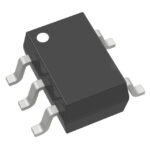 LD6815TD/29P,125
The activity of extra discounts on wholesale prices is in full swing…
Please fill in your contact information and we will send you the latest wholesale price list.




