 ChipApex | Global Electronic Components Supplier
SEARCH
Search Product
Search Post
— IC芯片 | 连接器 | 传感器 | 被动器件 —
Search productSearch post
— IC芯片 | 连接器 | 传感器 | 被动器件 —
Consult the customer manager about the wholesale price.
consultation hotline:86-132-6715-2157
email:[email protected]
Contact the product manager for consultation. One-stop consultation is available.
Do you want a lower wholesale price? Please send us your inquiry and we will reply immediately.
The LFB18868MBG9E212 is a balance matching band pass filter manufactured by Murata Electronics. It operates with a nominal center frequency of 869.50 MHz and supports a bandwidth range from 863 MHz to 876 MHz. The component features an insertion loss of approximately 1.9 dB to 2.1 dB and is designed for a nominal impedance of 50 Ohms. It utilizes LTCC technology and is housed in a compact 0603 (1608 Metric) surface-mount package with six pins. This device is specifically engineered to provide conjugate matching for the TI CC1310 microcontroller.
Verify that the specific application requires conjugate matching for the TI CC1310, as this component is highly specialized. Confirm that the system design accommodates the 0603 footprint and 50-ohm impedance requirements. Ensure compatibility with the target ISM band frequencies before integration. Check for any obsolescence notices, as some sources indicate potential discontinuation status for this specific part number.
Select this component only when designing for the TI CC1310 ecosystem, as it provides specific conjugate matching rather than generic filtering. It is suitable for applications requiring a narrow band pass characteristic around 869.5 MHz with minimal insertion loss. Consider the LTCC construction for thermal stability in automotive or industrial environments. Alternative generic filters may not provide the necessary impedance transformation for this specific MCU.
This component belongs to Murata's LTCC filter portfolio, which integrates passive components into ceramic structures for high-frequency applications. It serves as a critical interface element between antennas and low-noise amplifiers in wireless sensor nodes. The device addresses the need for precise impedance matching to maximize power transfer efficiency in compact IoT devices.
DE6E3KJ222MA4B is listed as a parameter equivalent substitute by distributors, though it is technically a ceramic capacitor and likely represents a database error. No other verified RF filter substitutes are confirmed in public documentation.

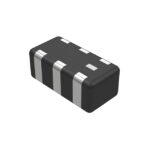 LFB18868MBG9E212
The activity of extra discounts on wholesale prices is in full swing…
Please fill in your contact information and we will send you the latest wholesale price list.




