ChipApex | Global Electronic Components Supplier
SEARCH
Search Product
Search Post
— IC芯片 | 连接器 | 传感器 | 被动器件 —
Search productSearch post
— IC芯片 | 连接器 | 传感器 | 被动器件 —
Consult the customer manager about the wholesale price.
consultation hotline:86-132-6715-2157
email:[email protected]
Contact the product manager for consultation. One-stop consultation is available.
Do you want a lower wholesale price? Please send us your inquiry and we will reply immediately.
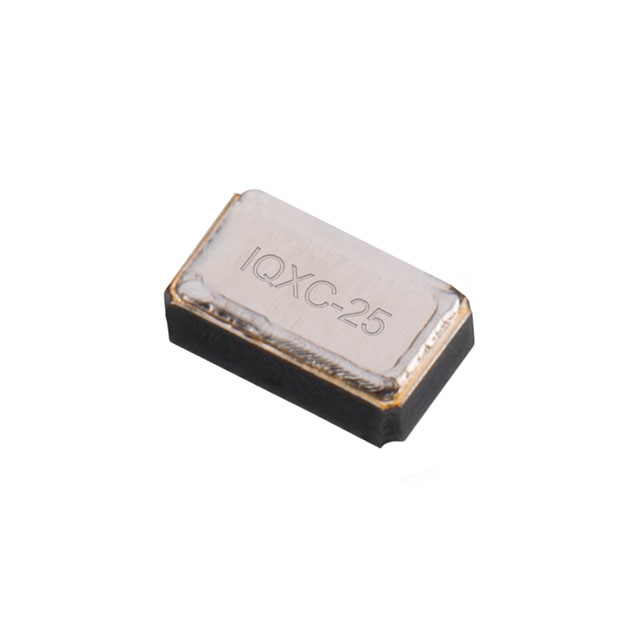
The LFXTAL065455 is a fundamental parallel quartz crystal from the IQXC-25 series, manufactured by IQD Frequency Products. It operates at a nominal frequency of 32.768 kHz with a tolerance of ±20 ppm and a stability of ±30 ppm. The component features a load capacitance of 6 pF and an equivalent series resistance (ESR) of 90 kOhms. Designed for surface-mount applications, it utilizes a 2-SMD, no-lead package. The device supports a drive level of 1 µW and functions within a temperature range of -40°C to +85°C.
Verify the specific packaging configuration, such as tape and reel or bulk, prior to ordering, as availability may vary by region. Confirm that the target circuit design accommodates the 6 pF load capacitance requirement to ensure accurate frequency performance. Check for RoHS compliance status if environmental regulations apply to your manufacturing process. Ensure the selected variant matches the required operating temperature range of -40°C to +85°C for your specific application environment.
Select this component when a standard 32.768 kHz reference is required for space-constrained designs. The 2-SMD no-lead package offers a compact footprint suitable for modern PCB layouts. Consider the 90 kOhm ESR value when designing the oscillator circuit to guarantee stable startup conditions. This part is appropriate for applications where moderate frequency stability of ±20 ppm is sufficient for long-term timekeeping accuracy.
This crystal belongs to the IQXC-25 series, which provides industry-standard surface-mount solutions. IQD Frequency Products specializes in quartz crystals and oscillators for global electronics markets. The LFXTAL065455 represents a common frequency choice for digital systems requiring precise second-based timing references without the need for complex calibration.
Direct substitutes must match the 32.768 kHz frequency, 6 pF load capacitance, and 2-SMD no-lead package dimensions. Verify equivalent ESR values and drive level sensitivity to prevent frequency pulling or failure to oscillate. Cross-reference mechanical tolerances to ensure compatibility with existing pick-and-place equipment and soldering profiles.
 LFXTAL065455
The activity of extra discounts on wholesale prices is in full swing…
Please fill in your contact information and we will send you the latest wholesale price list.