 ChipApex | Global Electronic Components Supplier

SEARCH
Search Product
Search Post
— IC芯片 | 连接器 | 传感器 | 被动器件 —
Search productSearch post
— IC芯片 | 连接器 | 传感器 | 被动器件 —
Consult the customer manager about the wholesale price.
consultation hotline:86-132-6715-2157
email:[email protected]
Contact the product manager for consultation. One-stop consultation is available.
Do you want a lower wholesale price? Please send us your inquiry and we will reply immediately.
The LM5175PWPT is a synchronous four-switch buck-boost DC/DC controller manufactured by Texas Instruments. It operates with an input voltage range of 3.5 V to 42 V, supporting peaks up to 60 V. The device regulates output voltages from 800 mV to 55 V and supports output currents up to 20 A. It features an adjustable switching frequency between 100 kHz and 600 kHz with 100% maximum duty cycle. The component is housed in a QFN-28 package, operates within a temperature range of -40°C to +125°C, and draws a typical operating supply current of 1.65 mA.
Verify the specific suffix 'PT' corresponds to the QFN-28 package variant when ordering. Confirm that the required application does not demand automotive qualification, as this standard part lacks AEC-Q100 certification. Ensure design compatibility with the specified HTSSOP or QFN footprint dimensions provided in the official datasheet before finalizing procurement.
Select this controller for designs requiring a single inductor solution to handle both step-up and step-down scenarios efficiently. It is suitable for applications where input voltage may frequently exceed or fall below the target output level. Consider the external MOSFET selection carefully to match the 20 A capability and switching speed requirements of the integrated drivers.
This component belongs to the LM5175 family of wide VIN synchronous buck-boost controllers. It shares core architectural similarities with the LM5176, which offers higher voltage ratings. The PWPT designation specifically identifies the plastic quad flat no-lead package variant within the broader product line.
LM5175PWP serves as the pin-compatible alternative in the HTSSOP-28 package. For automotive-grade requirements, consider the LM5175QPWPRQ1 or LM5175QPWPTQ1 variants which meet AEC-Q100 standards while maintaining functional equivalence.
Yes, the switching frequency can be synchronized to an external clock signal to reduce system-wide noise interference.
The device includes per-cycle current limiting, optional average input/output current limiting, hiccup mode for overloads, output overvoltage protection, and thermal shutdown.
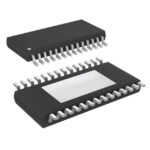 LM5175PWPT

The activity of extra discounts on wholesale prices is in full swing…
Please fill in your contact information and we will send you the latest wholesale price list.





