 ChipApex | Global Electronic Components Supplier
SEARCH
Search Product
Search Post
— IC芯片 | 连接器 | 传感器 | 被动器件 —
Search productSearch post
— IC芯片 | 连接器 | 传感器 | 被动器件 —
Consult the customer manager about the wholesale price.
consultation hotline:86-132-6715-2157
email:[email protected]
Contact the product manager for consultation. One-stop consultation is available.
Do you want a lower wholesale price? Please send us your inquiry and we will reply immediately.
The LM8500IMT9B is a four-wire resistive touchscreen controller manufactured by Texas Instruments. It features an integrated 10-bit analog-to-digital converter capable of sampling up to 500 coordinate pairs per second. The device operates on a single 5V supply with a brownout detection range of 4.17V to 4.5V and supports operating frequencies of 3.27 MHz or 10 MHz via the CLK_SET pin. Communication is handled through a UART interface at 38400 bps. Key electrical characteristics include a typical standby current of less than 2 µA at 5.5V and an operating temperature range of 0°C to +70°C.
Verify the specific suffix 'IMT9B' against the manufacturer's official documentation to confirm package type (TSSOP) and commercial temperature grade (0°C to +70°C). Ensure the design utilizes a 5V logic supply, as this variant includes brownout protection specific to that voltage rail. Cross-reference the datasheet revision SNAS158B–REVISED MARCH 2013 for accurate pin definitions and electrical limits.
Select the LM8500IMT9B when a dedicated 4-wire resistive solution with low standby power is required. The choice between 3.27 MHz and 10 MHz operation depends on the crystal connected to OSC_IN/OSC_OUT and the state of the CLK_SET pin. This component is suitable for applications needing on-chip calibration storage and pressure measurement, eliminating the need for external non-volatile memory components.
The LM8500 is part of the LM8300/LM8500 family of four-wire resistive touchscreen controllers. While functionally similar to the LM8300, the LM8500 distinguishes itself with specific brownout detection thresholds tailored for 5V systems (4.17V to 4.5V) and support for higher clock frequencies up to 10 MHz. Both devices share the same pinout and core functionality but differ in power management specifications.
The LM8300 is a functional alternative within the same family, though it lacks the specific 5V brownout detection features of the LM8500. Other manufacturers offer resistive controllers such as the Semtech SX8651 or STMicroelectronics STMPE812, but these may require significant schematic and firmware modifications due to differences in interface protocols and feature sets.
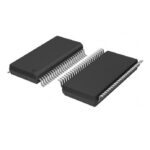 LM8500IMT9B
The activity of extra discounts on wholesale prices is in full swing…
Please fill in your contact information and we will send you the latest wholesale price list.





