ChipApex | Global Electronic Components Supplier

SEARCH
Search Product
Search Post
— IC芯片 | 连接器 | 传感器 | 被动器件 —
Search productSearch post
— IC芯片 | 连接器 | 传感器 | 被动器件 —
Consult the customer manager about the wholesale price.
consultation hotline:86-132-6715-2157
email:[email protected]
Contact the product manager for consultation. One-stop consultation is available.
Do you want a lower wholesale price? Please send us your inquiry and we will reply immediately.
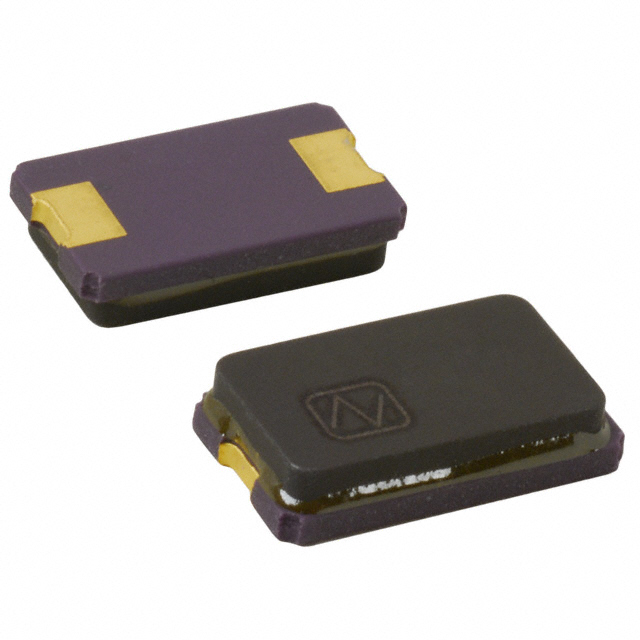
The LNCF001-40M is a surface-mount quartz crystal resonator manufactured by NDK (NIHON DEMPA KOGYO CO., LTD). It operates at a fundamental frequency of 40 MHz with a frequency stability of ±50 ppm. The component features an 8 pF load capacitance and an equivalent series resistance (ESR) of 50 Ohms. Designed for base mode operation, it utilizes a 2-SMD, no lead package with dimensions of 8.00 mm x 4.50 mm and a maximum height of 2.00 mm. The device supports a commercial operating temperature range of -10°C to +70°C and complies with RoHS standards.
Verify the specific frequency tolerance and load capacitance requirements against the target circuit design before procurement. Confirm that the operating temperature range of -10°C to +70°C aligns with the environmental conditions of the intended application. Ensure compatibility with the 2-SMD no-lead footprint during PCB layout review. Check for any end-of-life or not-for-new-designations status through official manufacturer channels prior to finalizing supply chain agreements.
Select this component when a 40 MHz fundamental frequency with ±50 ppm stability is required for space-constrained designs. The 8 pF load capacitance must match the oscillator circuit's external capacitive load. Consider the 50 Ohm ESR value for drive level sensitivity analysis. The commercial temperature range limits suitability for harsh environments requiring wider thermal specifications. Verify package dimensions fit within the designated board area constraints.
This part belongs to the NX8045GB series of surface-mount crystals from NDK. The series offers various frequency options within a standardized 2-SMD no-lead form factor. NDK manufactures these components using proprietary quartz processing technologies to ensure uniform quality. The LNCF001-40M represents one specific frequency variant within this broader product family designed for general-purpose timing applications.
Public documentation lists LNCD1-24M as a substitute part number from the same manufacturer. Verify electrical parameter compatibility including frequency, load capacitance, and ESR before substitution. Cross-reference pinout and mechanical dimensions to ensure physical interchangeability. Consult official manufacturer data sheets for detailed equivalence validation.
 LNCF001-40M

The activity of extra discounts on wholesale prices is in full swing…
Please fill in your contact information and we will send you the latest wholesale price list.