 ChipApex | Global Electronic Components Supplier

SEARCH
Search Product
Search Post
— IC芯片 | 连接器 | 传感器 | 被动器件 —
Search productSearch post
— IC芯片 | 连接器 | 传感器 | 被动器件 —
Consult the customer manager about the wholesale price.
consultation hotline:86-132-6715-2157
email:[email protected]
Contact the product manager for consultation. One-stop consultation is available.
Do you want a lower wholesale price? Please send us your inquiry and we will reply immediately.
The LT1172HVCT#PBF is a monolithic high-power switching regulator from Analog Devices, designed for versatile DC-DC conversion applications. It integrates a high-current, high-efficiency power switch along with complete oscillator, control, and protection circuitry on a single die. The device supports standard switching topologies including buck, boost, flyback, forward, inverting, and Cuk configurations. It operates with an input voltage range of 3 V to 60 V and delivers an adjustable output voltage up to 1.25 A. The unit functions at a fixed switching frequency of 100 kHz and is housed in a TO-220-5 package.
Verify the specific suffix and package type against the manufacturer's current product data sheet to ensure compatibility with thermal requirements and PCB layout constraints. Confirm that the integrated switch current rating aligns with the peak demands of the selected topology. Cross-reference the operating temperature range with the intended application environment to guarantee reliable performance under all conditions.
Select this component when a single-chip solution is required for multiple standard switching topologies without external discrete switches. The integrated protection circuitry simplifies design complexity compared to separate controller and MOSFET approaches. Ensure the input voltage does not exceed the maximum rated limit for the specific variant chosen. Consider the thermal dissipation capabilities of the TO-220-5 package for high-power continuous operation scenarios.
The LT1172 series belongs to Analog Devices' family of high-efficiency switching regulators, offering variants with different current ratings such as 5A and 2.5A. The HVCT designation indicates a high-voltage capable version in a TO-220-5 through-hole package. This part serves as a core power management IC for industrial and commercial power supplies requiring flexible topology support and robust internal switching capabilities.
LT1170HVCT#PBF offers similar functionality but with a higher output current capability of 5A instead of 1.25A. Designers must verify if the increased current capacity affects thermal management and component sizing in the existing circuit layout.
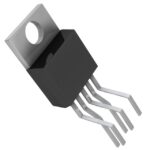 LT1172HVCT#PBF

The activity of extra discounts on wholesale prices is in full swing…
Please fill in your contact information and we will send you the latest wholesale price list.







