 ChipApex | Global Electronic Components Supplier
SEARCH
Search Product
Search Post
— IC芯片 | 连接器 | 传感器 | 被动器件 —
Search productSearch post
— IC芯片 | 连接器 | 传感器 | 被动器件 —
Consult the customer manager about the wholesale price.
consultation hotline:86-132-6715-2157
email:[email protected]
Contact the product manager for consultation. One-stop consultation is available.
Do you want a lower wholesale price? Please send us your inquiry and we will reply immediately.
The LT3695IMSE-3.3#TRPBF is a micropower step-down switching regulator manufactured by Analog Devices Inc., designed for high-voltage applications with fault tolerance. It operates within an input voltage range of 3.6 V to 36 V and provides a fixed 3.3 V output capable of delivering up to 1 A of continuous current. The device features a low quiescent current of 35 uA, ensuring efficient power management in standby modes. It supports adjustable switching frequencies from 250 kHz to 2.2 MHz, allowing optimization for size and performance. Packaged in a thermally enhanced MSOP-16 surface-mount package, it functions reliably across an extended temperature range of -40°C to +125°C.
Verify the specific suffix #TRPBF confirms tape-and-reel packaging when sourcing components. Ensure compatibility with MSOP-16 footprint requirements on printed circuit boards. Confirm that the fixed 3.3 V output variant matches system voltage rails. Check manufacturer documentation for any recent product change notifications affecting pinout or thermal characteristics before finalizing procurement orders.
Select this component when designing systems requiring high input voltage tolerance combined with low quiescent current. The fixed 3.3 V output eliminates external resistor networks, simplifying layout compared to adjustable variants. Consider the MSOP-16 package constraints for thermal dissipation if operating near maximum current limits. Evaluate switching frequency options to balance electromagnetic interference against passive component sizes.
This part belongs to the LT3695 series of buck regulators from Analog Devices, characterized by high-voltage operation and fault protection. It complements other parts in the family like the LT3695IMSE-5#PBF, differing primarily in output voltage configuration and packaging format. The series targets applications needing reliable power conversion in electrically noisy environments.
LT3695IMSE-5#PBF serves as a functional substitute within the same series, offering identical electrical characteristics except for a fixed 5 V output instead of 3.3 V. Designers must verify that downstream loads tolerate the higher voltage level before implementing this cross-reference.
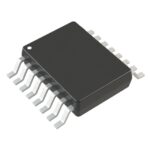 LT3695IMSE-3.3#TRPBF
The activity of extra discounts on wholesale prices is in full swing…
Please fill in your contact information and we will send you the latest wholesale price list.





