 ChipApex | Global Electronic Components Supplier
SEARCH
Search Product
Search Post
— IC芯片 | 连接器 | 传感器 | 被动器件 —
Search productSearch post
— IC芯片 | 连接器 | 传感器 | 被动器件 —
Consult the customer manager about the wholesale price.
consultation hotline:86-132-6715-2157
email:[email protected]
Contact the product manager for consultation. One-stop consultation is available.
Do you want a lower wholesale price? Please send us your inquiry and we will reply immediately.
The LT6109HMS-1#TRPBF is a high-side current sense amplifier with integrated reference and comparators, manufactured by Analog Devices Inc. It operates within a supply voltage range of 2.7V to 60V and draws a typical supply current of 475µA at 2.7V. The device features a 1MHz bandwidth, 125dB common-mode rejection ratio, and a maximum input offset voltage of 350µV. It includes two comparators with opposing polarity, an internal 400mV precision reference, and open-drain outputs. The component is specified for operation from –40°C to 125°C and is housed in a 10-lead MSOP package.
Verify the specific suffix #TRPBF indicates tape and reel packaging when sourcing. Confirm the HMS designation corresponds to the industrial temperature grade ranging from –40°C to 125°C. Ensure compatibility with the 10-lead MSOP footprint during PCB design. Cross-reference the manufacturer's ordering information to validate lead-free finish specifications.
Select this variant for applications requiring opposing polarity comparator outputs for distinct overcurrent and undercurrent flagging. The high common-mode rejection ratio suits noisy environments with wide supply voltage variations. Consider the 125µV to 350µV offset voltage limits when designing for low-current precision measurements. Verify that the 1mA output current capability meets the drive requirements of the downstream circuitry or ADC inputs.
This component belongs to the LT6109 family of high-side current sense amplifiers. The LT6109-1 version specifically configures the internal comparators with opposing polarities, distinguishing it from the LT6109-2 which shares the same polarity. The H-grade ensures extended temperature performance suitable for demanding industrial and automotive sectors compared to the standard I-grade.
LT6109HMS-1#PBF (Tube Packaging)
The LT6109-1 has comparators connected in opposing polarity, while the LT6109-2 has comparators connected in the same polarity.
The gain is configured by external resistors, specifically RIN and ROUT, where the voltage gain is determined by the ratio of these resistors.
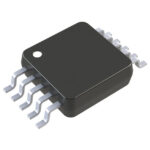 LT6109HMS-1#TRPBF
The activity of extra discounts on wholesale prices is in full swing…
Please fill in your contact information and we will send you the latest wholesale price list.






