ChipApex | Global Electronic Components Supplier
SEARCH
Search Product
Search Post
— IC芯片 | 连接器 | 传感器 | 被动器件 —
Search productSearch post
— IC芯片 | 连接器 | 传感器 | 被动器件 —
Consult the customer manager about the wholesale price.
consultation hotline:86-132-6715-2157
email:[email protected]
Contact the product manager for consultation. One-stop consultation is available.
Do you want a lower wholesale price? Please send us your inquiry and we will reply immediately.
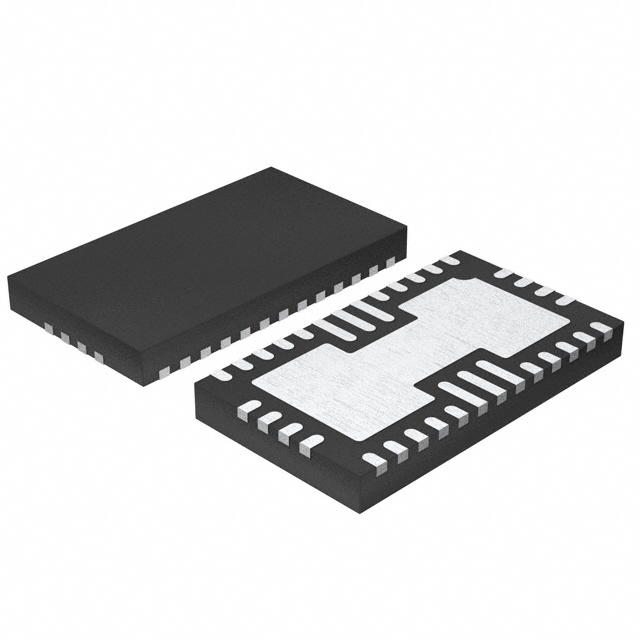
The LT6604CUFF-2.5#PBF is a dual-channel integrated circuit featuring very low noise differential amplifiers and 2.5MHz fourth-order lowpass filters with Chebyshev response characteristics. It operates on supply voltages ranging from 3V to 11V, drawing approximately 28mA per channel at 5V. The device provides a signal-to-noise ratio exceeding 86dB at unity gain with a 3V supply. Key electrical parameters include a common-mode rejection ratio of 63dB, input bias current of -35µA typical, and differential output swing up to 9.3VP-P at 5V. It is housed in a 34-lead 4mm x 7mm QFN package.
Verify the specific suffix 'CUFF' indicates the commercial temperature grade (0°C to 70°C) and plastic QFN packaging as distinct from industrial variants. Confirm lead-free finish compliance with RoHS standards prior to ordering. Ensure PCB layout accommodates the exposed pad connection to the negative supply for thermal management and electrical grounding.
Select this component when a combined amplifier and sharp cutoff filter is required to minimize board space and component count. The fixed 2.5MHz cutoff suits applications where bandwidth limitation is static. Consider the 34-lead QFN package constraints for thermal dissipation and soldering requirements compared to larger packages if higher power handling is needed.
This part belongs to the LT6604 family of dual differential amplifiers with integrated lowpass filters. Variants within the series offer different cutoff frequencies ranging from 2.5MHz to 20MHz. The CUFF designation specifically identifies the commercial grade version in the small form factor QFN package, distinguishing it from industrial temperature range options.
LT6604IUFF-2.5#PBF offers identical electrical performance but is specified for an extended operating temperature range of –40°C to 85°C.
The differential gain is set by two equal external input resistors (RIN). The DC gain is calculated as 1580Ω divided by RIN.
The VMID pin sets the output common mode voltage for the first filter stage. It is internally biased at mid-supply but can be overridden by an external low-impedance source.
 LT6604CUFF-2.5#PBF
The activity of extra discounts on wholesale prices is in full swing…
Please fill in your contact information and we will send you the latest wholesale price list.