ChipApex | Global Electronic Components Supplier
SEARCH
Search Product
Search Post
— IC芯片 | 连接器 | 传感器 | 被动器件 —
Search productSearch post
— IC芯片 | 连接器 | 传感器 | 被动器件 —
Consult the customer manager about the wholesale price.
consultation hotline:86-132-6715-2157
email:[email protected]
Contact the product manager for consultation. One-stop consultation is available.
Do you want a lower wholesale price? Please send us your inquiry and we will reply immediately.
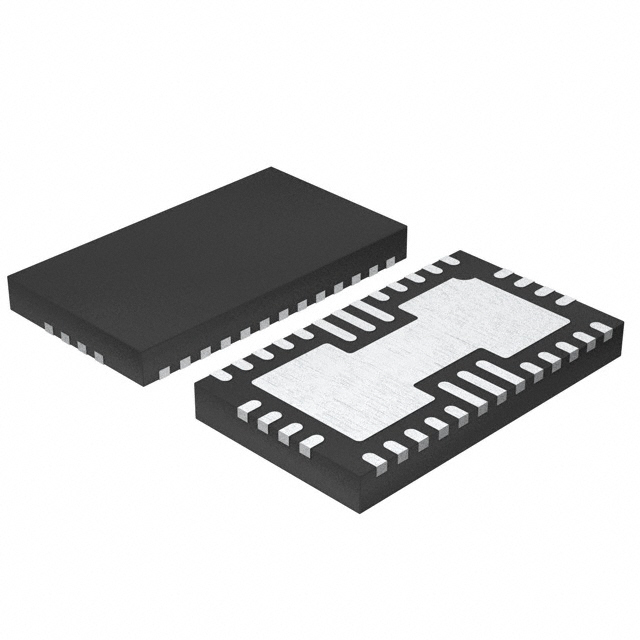
The LT6604IUFF-5#PBF is a dual very low noise differential amplifier and 5MHz lowpass filter. It integrates two matched fully differential amplifiers, each with a fourth-order lowpass filter approximating a Chebyshev response. The device operates on a single 3V supply or ±5V supplies. Key electrical parameters include a gain bandwidth product of 5MHz, a common mode rejection ratio of 63dB, and a maximum power supply voltage of 11V. It draws 26mA of operating current and is housed in a 34-lead QFN package.
Verify the specific suffix IUFF-5#PBF against the manufacturer's official ordering guide to confirm the industrial temperature range (-40°C to 85°C) and lead-free finish. Ensure the 34-lead QFN package dimensions match your PCB footprint requirements. Cross-reference the datasheet revision date to validate all electrical specifications before finalizing procurement.
Select this component when a dual-channel solution with integrated filtering is required to minimize board space and external components. It is suitable for applications needing high channel-to-channel matching and low distortion. Consider the 5MHz cutoff frequency and the need for external resistors to set gain. Verify that the 3V to 11V supply range aligns with the system power architecture.
This part belongs to the LT6604 family of dual differential amplifiers with integrated lowpass filters. Variants within the series offer different cutoff frequencies, such as 2.5MHz, 10MHz, and 15MHz. The 'I' designation indicates an extended industrial temperature range compared to commercial grade options. The '#PBF' suffix denotes a lead-free and RoHS compliant packaging option.
LT6604CUFF-5#PBF
The differential gain for each channel is independently programmed using two equal external input resistors (RIN). The DC gain is determined by the ratio of the internal 806Ω feedback resistor to the external RIN value.
The VOCM pin sets the DC common mode reference voltage for the second filter stage. It programs the common mode voltage of the differential output and can be driven by an external voltage reference or tied to the VMID pin.
Yes, the device is fully specified for operation with a single 3V supply. It can also operate with dual supplies up to ±5V, providing flexibility for various system architectures.
 LT6604IUFF-5#PBF
The activity of extra discounts on wholesale prices is in full swing…
Please fill in your contact information and we will send you the latest wholesale price list.