 ChipApex | Global Electronic Components Supplier
SEARCH
Search Product
Search Post
— IC芯片 | 连接器 | 传感器 | 被动器件 —
Search productSearch post
— IC芯片 | 连接器 | 传感器 | 被动器件 —
Consult the customer manager about the wholesale price.
consultation hotline:86-132-6715-2157
email:[email protected]
Contact the product manager for consultation. One-stop consultation is available.
Do you want a lower wholesale price? Please send us your inquiry and we will reply immediately.
The LTC1067CS#TRPBF is a dual, rail-to-rail, very low noise universal switched-capacitor building block. It integrates two identical second-order filter sections capable of realizing bandpass, highpass, lowpass, notch, and allpass functions using three to five external resistors. The center frequency is tuned by an external clock with a nominal 100:1 ratio for the LTC1067 variant. It operates from a single 3V supply or dual supplies up to ±5V, consuming approximately 4.5mA at 250kHz. The device provides over 80dB dynamic range on a 3.3V supply with less than 40mVRMS noise for Q ≤ 5.
Verify the specific suffix #TRPBF indicates tape and reel packaging when sourcing. Confirm the 'C' grade corresponds to the commercial temperature range of 0°C to 70°C. Ensure the clock source meets the specified logic level thresholds for the chosen supply voltage to prevent improper switching behavior.
Select this component when a dual filter solution is required within a limited footprint. The LTC1067-50 variant offers lower power consumption if current efficiency is prioritized over maximum clock speed. Verify that the required center frequency range falls within the 0.001 to 20 kHz limit for optimal performance.
This part belongs to the LTC1067 family of universal switched-capacitor filters. It serves as a building block for higher-order filter designs. The CS designation identifies the plastic SOIC-16 package variant. It complements other Linear Technology analog signal processing components.
The LTC1067-50 is a lower-power alternative within the same family. Mask programmable versions are available for custom clock-to-cutoff ratios in an SO-8 package. Direct pin-compatible replacements require matching the 16-lead SSOP/SO form factor and switched-capacitor architecture.
The LTC1067 has a fixed internal clock-to-center frequency ratio of 100:1.
Clock feedthrough can be reduced by adding a simple RC lowpass network at the final filter output and ensuring proper PCB layout with isolated analog ground planes.
Yes, the device operates from a single 3V supply or dual supplies up to ±5V, with rail-to-rail input and output capabilities.
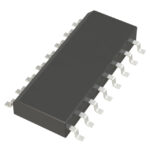 LTC1067CS#TRPBF
The activity of extra discounts on wholesale prices is in full swing…
Please fill in your contact information and we will send you the latest wholesale price list.





