 ChipApex | Global Electronic Components Supplier

SEARCH
Search Product
Search Post
— IC芯片 | 连接器 | 传感器 | 被动器件 —
Search productSearch post
— IC芯片 | 连接器 | 传感器 | 被动器件 —
Consult the customer manager about the wholesale price.
consultation hotline:86-132-6715-2157
email:[email protected]
Contact the product manager for consultation. One-stop consultation is available.
Do you want a lower wholesale price? Please send us your inquiry and we will reply immediately.
The LTC1143LCS-ADJ#PBF is a dual step-down switching regulator controller manufactured by Analog Devices Inc. It features two independent regulator blocks, each driving an external power MOSFET at switching frequencies up to 400kHz using a constant off-time current mode architecture. The device supports automatic Burst Mode operation to maintain high efficiencies at low output currents. Input voltage ranges from 4V to 14V or 3.5V to 16V depending on specific configuration. Output voltages include fixed options such as 2.5V, 3.3V, and 5V, with output currents up to 2A per channel.
Verify the exact suffix (e.g., #PBF) against the manufacturer's datasheet to confirm lead-free compliance and package type. Ensure input voltage requirements align with the specified range of 4V to 14V or 3.5V to 16V. Confirm thermal management needs for the SO-16 package under maximum load conditions. Cross-reference pinouts with official documentation to avoid integration errors during PCB layout.
Select this component when dual isolated or non-isolated buck converters are required in a compact form factor. The 400kHz switching frequency allows for smaller passive components compared to lower-frequency alternatives. Consider the automatic Burst Mode feature if system efficiency at idle or light load is critical. Verify that external MOSFETs can handle the drive capabilities and switching speeds supported by the controller.
This part belongs to the LTC1143 series of dual synchronous buck regulators. It is designed for applications requiring two regulated outputs from a single input source. The series includes variants with different fixed output voltages and packages. The LCS-ADJ variant specifically denotes the SO-16 package version with adjustable or fixed output configurations as per the datasheet.
Check for direct pin-compatible replacements within the LTC114x family, such as other suffixes of the LTC1143LCS. Verify electrical parameters like input voltage range and switching frequency match the original design requirements. Ensure thermal performance and package dimensions are compatible with the existing footprint.
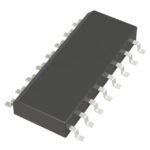 LTC1143LCS-ADJ#PBF

The activity of extra discounts on wholesale prices is in full swing…
Please fill in your contact information and we will send you the latest wholesale price list.




