 ChipApex | Global Electronic Components Supplier
SEARCH
Search Product
Search Post
— IC芯片 | 连接器 | 传感器 | 被动器件 —
Search productSearch post
— IC芯片 | 连接器 | 传感器 | 被动器件 —
Consult the customer manager about the wholesale price.
consultation hotline:86-132-6715-2157
email:[email protected]
Contact the product manager for consultation. One-stop consultation is available.
Do you want a lower wholesale price? Please send us your inquiry and we will reply immediately.
The LTC1569IS8-6#TRPBF is a 10th order lowpass filter featuring linear phase and a root raised cosine amplitude response. It operates from single 3V to dual ±5V supplies with a maximum supply voltage of 11V. The device offers a typical cutoff frequency of 64kHz using a single external resistor, with power supply current ranging from 3mA at 3V to 17mA at 10V depending on the clock divider setting. It provides a maximum DC offset of 5mV and an 82dB signal-to-noise ratio at 5V.
Verify the specific suffix #TRPBF indicates tape and reel packaging when sourcing this component. Confirm that the IS grade meets the required operating temperature range of –40°C to 85°C for your application environment. Ensure the SO-8 package dimensions align with your PCB footprint requirements before finalizing procurement.
Select this part when a 10th order response with linear phase characteristics is required in a compact surface-mount package. Consider the divide-by-4 or divide-by-16 modes if lower power consumption is necessary, as these settings reduce supply current significantly compared to the divide-by-1 mode while maintaining filtering performance.
This component belongs to the LTC1569 family of sampled data filters. It shares architectural similarities with other members like the LTC1569C but differs in temperature rating and specific cutoff frequency testing conditions. The IS variant is specifically characterized for industrial temperature ranges, distinguishing it from commercial grade equivalents within the same product line.
Public confirmed substitute part numbers are not available in the provided documentation.
The cutoff frequency is set by a single external resistor connected between the RX pin and V+. The internal oscillator frequency is divided by 1, 4, or 16 based on the DIV/CLK pin configuration, allowing the cutoff frequency to be programmed over a range of six octaves.
The GND pin serves as the reference voltage for the filter. For single supply operation, it should be externally biased (e.g., 2V for 5V supply) to maximize dynamic range, whereas for dual supply applications, it connects directly to ground.
Yes, the internal oscillator can be disabled by shorting the RX pin to V–. In this mode, the DIV/CLK pin accepts an external square wave clock signal, where the cutoff frequency is derived from the clock frequency divided by 64.
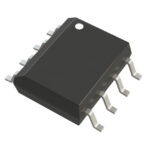 LTC1569IS8-6#TRPBF
The activity of extra discounts on wholesale prices is in full swing…
Please fill in your contact information and we will send you the latest wholesale price list.





