 ChipApex | Global Electronic Components Supplier

SEARCH
Search Product
Search Post
— IC芯片 | 连接器 | 传感器 | 被动器件 —
Search productSearch post
— IC芯片 | 连接器 | 传感器 | 被动器件 —
Consult the customer manager about the wholesale price.
consultation hotline:86-132-6715-2157
email:[email protected]
Contact the product manager for consultation. One-stop consultation is available.
Do you want a lower wholesale price? Please send us your inquiry and we will reply immediately.
LTC6904CMS8#TRPBF is listed in the Programmable Timers And Oscillators range at ChipApex. The manufacturer field lists Analog Devices Inc.. Its product description is IC OSC SILICON PROG 8-MSOP. Review the specifications below when checking this part for your BOM.
The Analog Devices LTC6904CMS8#TRPBF is a low-power, self-contained digital frequency source providing a precision square wave output from 1.039 kHz to 68 MHz. It operates on a single supply voltage ranging from 2.7 V to 5.5 V and requires no external components other than a power supply bypass capacitor. The device features an industry-standard I2C compatible serial interface for digital control. Key electrical specifications include a typical initial frequency accuracy of 0.5%, a maximum operating frequency of 68 MHz, and a typical supply current of 1.7 mA at frequencies below 1 MHz with a 2.7 V supply.
Verify that the specific ordering suffix #TRPBF corresponds to the Tape and Reel packaging format as indicated in the manufacturer's order information table. Confirm that the component grade matches the required operational temperature range, as the CMS8 designation specifies a commercial range of 0°C to 70°C with extended functional capabilities down to -40°C.
Select the LTC6904 over the LTC6903 when an I2C interface is preferred over the SPI-compatible interface. Ensure the application environment remains within the 0°C to 70°C guaranteed specification range for the CMS8 package; otherwise, consider the IMS8 or HMS8 variants for wider industrial or high-temperature ranges. Verify that the load capacitance on the CLK outputs does not exceed 5 pF to maintain specified accuracy without requiring additional buffering.
This component belongs to the LTC6903/LTC6904 family of low-power programmable oscillators manufactured by Analog Devices (formerly Linear Technology). The LTC6904 specifically distinguishes itself through its I2C interface, whereas the LTC6903 uses an SPI-compatible interface. Both share identical internal feedback loops and frequency setting equations but differ in their serial communication protocols.
The LTC6903CMS8#TRPBF serves as a direct functional substitute if the system design accommodates the SPI-compatible interface instead of I2C. For applications requiring higher maximum frequencies up to 30 MHz with lower power consumption, the LTC1799 may be considered, though it lacks the wide-range programmability of the LTC6904.
["What is the default output frequency upon power-up?","The device defaults to an output frequency of 1.039 kHz with both CLK outputs active immediately after power is applied."]
["How is the slave address determined for the I2C interface?","The first six bits of the 7-bit address are factory-programmed to 001011. The least significant bit is determined by the logic level on the ADR pin (Pin 4); pulling ADR low sets the address to 0010111, while pulling it high sets it to 0010110."]
["What is the impact of capacitive loading on output accuracy?","The device is designed to drive up to 5 pF on each output without degradation. Exceeding this load, such as using a standard 10x oscilloscope probe (10-15 pF), may degrade accuracy and typically requires a high-speed buffer for signals above 1 MHz."]
Explore related parts through Clock/Timing, Integrated Circuits (ICs), all product categories, ChipApex homepage.


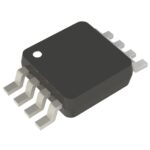 LTC6904CMS8#TRPBF

The activity of extra discounts on wholesale prices is in full swing…
Please fill in your contact information and we will send you the latest wholesale price list.



