ChipApex | Global Electronic Components Supplier

SEARCH
Search Product
Search Post
— IC芯片 | 连接器 | 传感器 | 被动器件 —
Search productSearch post
— IC芯片 | 连接器 | 传感器 | 被动器件 —
Consult the customer manager about the wholesale price.
consultation hotline:86-132-6715-2157
email:[email protected]
Contact the product manager for consultation. One-stop consultation is available.
Do you want a lower wholesale price? Please send us your inquiry and we will reply immediately.
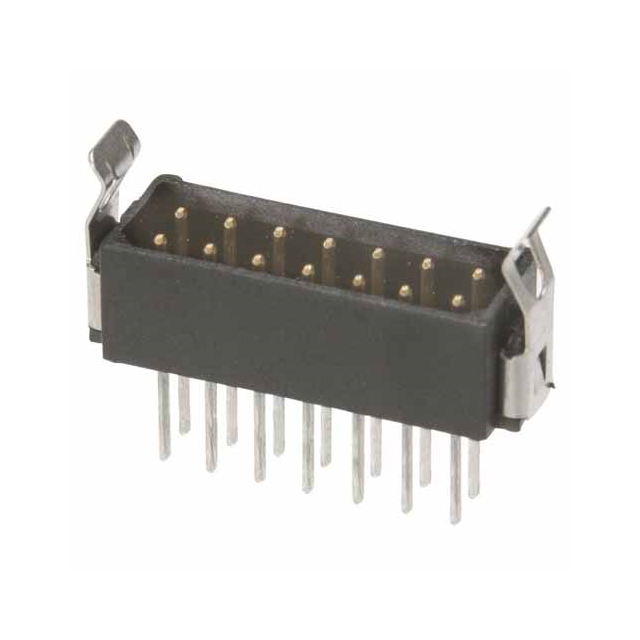
The M80-7532645 is a vertical board-to-board connector header from the Datamate L-Tek series by Harwin Inc. It features 26 positions in a dual-row configuration with a 2.00 mm (0.079 inch) mating pitch. Designed for through-hole mounting, it utilizes male pins with gold-plated contacts and a black polyphenylene sulfide (PPS) insulator rated UL 94 V-0. The connector employs a friction latch locking mechanism and operates within a temperature range of -55°C to +125°C, supporting a rated current of 3 A at 120 V.
Verify the specific suffix codes against official Harwin documentation to confirm contact plating thickness and material composition. Ensure compatibility with corresponding female connectors in the Datamate L-Tek family. Confirm that the friction latch style meets the mechanical retention requirements of the target assembly before finalizing procurement specifications.
Select this component when a low-profile, vertically mounted header with integrated latching is required. The 2.00 mm pitch allows for dense circuit board layouts. Consider the 3 A current rating and 120 V voltage limit for electrical compliance. Verify that the through-hole termination method aligns with the manufacturing process capabilities of the printed circuit board.
This part belongs to the Datamate L-Tek series, designed for applications where standard J-Tek connectors are unsuitable due to space or cost constraints. The L-Tek line offers a simplified locking mechanism compared to the screw-lock J-Tek variants. It maintains the same mating dimensions as the broader Datamate family, ensuring interchangeability in housing designs while offering a distinct mechanical engagement profile.
Direct substitutes must match the 26-position count, 2.00 mm pitch, and vertical orientation. Compatible alternatives include other Harwin Datamate L-Tek headers with identical pin counts. Cross-brand replacements require verification of mating interface geometry, latch force characteristics, and PCB footprint dimensions to ensure functional equivalence.
 M80-7532645

The activity of extra discounts on wholesale prices is in full swing…
Please fill in your contact information and we will send you the latest wholesale price list.