 ChipApex | Global Electronic Components Supplier

SEARCH
Search Product
Search Post
— IC芯片 | 连接器 | 传感器 | 被动器件 —
Search productSearch post
— IC芯片 | 连接器 | 传感器 | 被动器件 —
Consult the customer manager about the wholesale price.
consultation hotline:86-132-6715-2157
email:[email protected]
Contact the product manager for consultation. One-stop consultation is available.
Do you want a lower wholesale price? Please send us your inquiry and we will reply immediately.
The MAX16922ATPE/V+T is an automotive-grade Power Management IC (PMIC) from Analog Devices/Maxim Integrated, designed for high-efficiency power conversion in demanding environments. It integrates two independent 2.2 MHz synchronous buck DC-DC converters and two low-dropout (LDO) regulators within a single package. The device supports an input voltage range of 3.7 V to 28 V and delivers output currents up to 1.2 A for the switching regulators and 300 mA for the LDOs. It features fixed output voltages of 1 V, 2.7 V, 3.3 V, and 5 V, with a load regulation of ±0.2%. Operating reliably between -40°C and +125°C, it is qualified to AEC-Q100 standards and housed in a compact 20-pin TQFN-EP package.
Verify the specific suffix 'V+T' indicates tape-and-reel packaging when sourcing. Confirm AEC-Q100 qualification status is required for your automotive application. Check current availability as distribution may be limited or subject to allocation. Ensure the 20-TQFN footprint matches your PCB design constraints before finalizing procurement.
Select this component when a single IC solution is needed for multiple voltage rails in automotive electronics. It is suitable for designs requiring high efficiency at light loads due to the 2.2 MHz frequency. Consider the 28 V maximum input rating for standard 12 V automotive systems with load dump conditions. Verify that the integrated LDOs meet the noise sensitivity requirements of downstream analog circuits.
This part belongs to the MAX16922 family of automotive PMICs. It shares functional similarities with other Maxim Integrated buck converter families but is distinct in its integration of dual switches and dual LDOs. The 'ATPE' designation specifies the automotive temperature grade, plastic package type, and reel packaging format within the broader product line.
Direct pin-to-pin replacements are not explicitly confirmed in public documentation. Evaluate alternatives like the MAX16922ATPK/V+ for tube packaging differences or the MAX16922ATPA-V- for potential legacy compatibility. Always verify electrical parameters and thermal performance against the original datasheet before substitution.
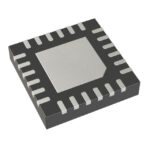 MAX16922ATPE/V+T

The activity of extra discounts on wholesale prices is in full swing…
Please fill in your contact information and we will send you the latest wholesale price list.





