 ChipApex | Global Electronic Components Supplier

SEARCH
Search Product
Search Post
— IC芯片 | 连接器 | 传感器 | 被动器件 —
Search productSearch post
— IC芯片 | 连接器 | 传感器 | 被动器件 —
Consult the customer manager about the wholesale price.
consultation hotline:86-132-6715-2157
email:[email protected]
Contact the product manager for consultation. One-stop consultation is available.
Do you want a lower wholesale price? Please send us your inquiry and we will reply immediately.
MAX20801TPBB+T is listed in the Specialized ICS range at ChipApex. The manufacturer field lists Analog Devices Inc./Maxim Integrated. Its product description is IC CELL-STRING OPTIMIZER 10FCQFN. Review the specifications below when checking this part for your BOM.
The MAX20801TPBB+T is a cell-string optimizer from Analog Devices/Maxim Integrated, designed for photovoltaic (PV) applications. It performs Maximum Power Point Tracking (MPPT) on strings of 20-24 series-connected PV cells. The device operates within an input voltage range of 1.5V to 18V and provides an output current capability up to 12A. Packaged in a 10-FCQFN (5.8x3mm) surface-mount case, it integrates synchronous buck converter topology with precision control circuitry. Key electrical parameters include a peak efficiency of 99.1% and an MPPT loop response time of 0.4ms.
Verify the package type is 10-FCQFN and the suffix +T indicates tape and reel packaging. Confirm the specific TPBB variant matches the required current limit specifications compared to other MAX20801 subtypes like TPBA or TPBD. Ensure compliance with RoHS standards as indicated by the '+' designation.
Select this component when optimizing individual cell strings rather than whole modules. Consider the 1.5V to 18V input range and 12A output current limits against the specific PV cell string characteristics. Evaluate thermal resistance requirements given the 1°C/W junction-to-case rating on a four-layer board.
The MAX20801 family replaces traditional bypass diodes with active DC-DC conversion. This allows each cell string to operate at its own maximum power point independently, mitigating losses caused by mismatch, shading, or soiling across the PV array.
Public confirmed substitute part numbers are not available in the provided documentation.
Under extremely low irradiance where MPPT is not possible, the device reverts to Active Bypass mode. In this state, the low-side power FET enables a low-resistance connection from PV- to OUT, while the high-side FET remains disabled to prevent reverse breakdown.
The typical MPPT efficiency is 99.9%. Peak efficiency reaches 99.1%, CEC efficiency is 98.7%, and European-weighted efficiency is 98.3%.
Yes. When exposed to reverse currents, the device enters Reverse Current mode, disabling MPPT and operating the DC-DC converter at maximum duty cycle to pass current back into the PV cells, supporting standard electroluminescence testing procedures.
Explore related parts through Integrated Circuits (ICs), all product categories, ChipApex homepage.
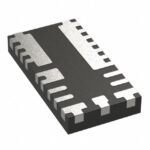 MAX20801TPBB+T

The activity of extra discounts on wholesale prices is in full swing…
Please fill in your contact information and we will send you the latest wholesale price list.





