 ChipApex | Global Electronic Components Supplier

SEARCH
Search Product
Search Post
— IC芯片 | 连接器 | 传感器 | 被动器件 —
Search productSearch post
— IC芯片 | 连接器 | 传感器 | 被动器件 —
Consult the customer manager about the wholesale price.
consultation hotline:86-132-6715-2157
email:[email protected]
Contact the product manager for consultation. One-stop consultation is available.
Do you want a lower wholesale price? Please send us your inquiry and we will reply immediately.
MAX2208EBS+ is listed in the RF Detectors range at ChipApex. The manufacturer field lists Analog Devices Inc./Maxim Integrated. Its product description is RF POWER DETECTOR IN UCSP. Review the specifications below when checking this part for your BOM.
The MAX2208EBS+ is an RF power detector manufactured by Analog Devices Inc./Maxim Integrated, designed for CDMA applications. It operates within a frequency range of 800 MHz to 2000 MHz and supports a maximum continuous wave input power of 17 dBm. The device features a positive output polarity and utilizes a UCSP-4 surface-mount package with dimensions of 2 x 2 mm. It is constructed using silicon technology and includes internal termination resistors compatible with directional couplers.
Verify component authenticity through authorized distributors due to obsolescence status. Confirm RoHS compliance documentation matches the specific manufacturing lot. Check for alternative sourcing channels as standard supply may be restricted. Ensure storage conditions adhere to moisture sensitivity level requirements prior to assembly.
Select this component when designing for CDMA frequencies between 800 MHz and 2000 MHz. Consider the 17 dBm input power limit for appropriate signal conditioning. The UCSP-4 package is suitable for space-constrained mobile designs. Evaluate compatibility with existing directional coupler topologies due to integrated termination resistors.
The MAX2208 belongs to the MAX2205–MAX2208 series of RF power detectors. These components share similar functional characteristics and are often used interchangeably in CDMA applications. The series provides compact solutions for power monitoring in wireless terminals, with variations primarily in pinout or specific tuning parameters.
Public confirmed substitute part numbers include MAX2206EBS+ and MAX2205EBS+. Verify electrical parameter alignment and package compatibility before substitution.
Explore related parts through RF and Wireless, all product categories, ChipApex homepage.
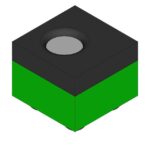 MAX2208EBS+

The activity of extra discounts on wholesale prices is in full swing…
Please fill in your contact information and we will send you the latest wholesale price list.







