 ChipApex | Global Electronic Components Supplier

SEARCH
Search Product
Search Post
— IC芯片 | 连接器 | 传感器 | 被动器件 —
Search productSearch post
— IC芯片 | 连接器 | 传感器 | 被动器件 —
Consult the customer manager about the wholesale price.
consultation hotline:86-132-6715-2157
email:[email protected]
Contact the product manager for consultation. One-stop consultation is available.
Do you want a lower wholesale price? Please send us your inquiry and we will reply immediately.
The MAX22506EASA+T is a half-duplex RS-485/RS-422 transceiver manufactured by Analog Devices Inc./Maxim Integrated. It supports data rates up to 50Mbps and operates within a supply voltage range of 3V to 5.5V. The device features integrated ESD protection rated at ±15kV (Human Body Model) and withstands over ±4kV Electrical Fast Transient (EFT). It includes hot-swap protection, fail-safe receiver functionality, and low-power shutdown mode with a maximum current of 5μA. The component is housed in an 8-pin SOIC package and functions across a temperature range of -40°C to +125°C.
Verify the specific ordering suffix to confirm the tape-and-reel packaging format required for automated assembly. Confirm that the component meets RoHS standards as indicated by the plus sign in the part number. Ensure compatibility with the target PCB footprint for the 8-pin SOIC package before finalizing procurement orders.
Select this transceiver for applications requiring high-speed communication up to 50Mbps in electrically noisy industrial environments. The integrated ESD and EFT protection reduces the need for external components. Consider the low shutdown current for battery-powered systems and the wide operating temperature range for harsh conditions.
This component belongs to the MAX22506E series of RS-485/RS-422 transceivers designed for robust communication. It is part of Analog Devices' portfolio of interface ICs optimized for industrial automation and control networks. The device complements other high-speed transceivers in the Maxim Integrated lineup.
Public confirmed substitute part numbers are not available in the provided documentation. Verify pinout and electrical specifications carefully if considering alternative manufacturers.
The fail-safe receiver guarantees a logic-high on the receiver output when the differential input voltage is between ±50mV for more than 10μs, such as when inputs are shorted or open.
Hot-swap protection holds the driver enable low and receiver enable high for at least 10μs upon power-up, preventing unwanted driver activation during board insertion or power sequencing.
Yes, the driver outputs can be used in standard differential mode or as individual standard TTL or CMOS logic outputs due to their rail-to-rail swing capability.
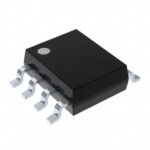 MAX22506EASA+T

The activity of extra discounts on wholesale prices is in full swing…
Please fill in your contact information and we will send you the latest wholesale price list.





